B2B Content Marketing for SaaS: A Revenue-First Strategy for Lean Teams
A revenue-first B2B SaaS content marketing strategy for lean teams, connecting positioning, buyer intent, content architecture, distribution, conversion, and measurement.
If you run a B2B SaaS company, content marketing usually starts with good intentions and ends in a traffic report nobody can tie to revenue.
You publish blog posts. Maybe a few comparison pages. Maybe a founder thought-leadership piece when there is time. Traffic inches up. But pipeline does not move enough, sales still says leads are uneducated, and your website sounds like every other company in your category.
That is the core problem with most B2B content marketing strategy work today: it is built around output, not commercial outcomes.
For technical founders, early-stage SaaS teams, and lean marketing functions, a strong b2b saas content marketing strategy should do three things at once:
- Clarify what your product does and why it matters
- Create content that matches buyer intent across the journey
- Support pipeline, sales conversations, and conversion, not just awareness
That means content cannot be treated as a standalone SEO program. It has to sit on top of positioning, product marketing, and buyer understanding.
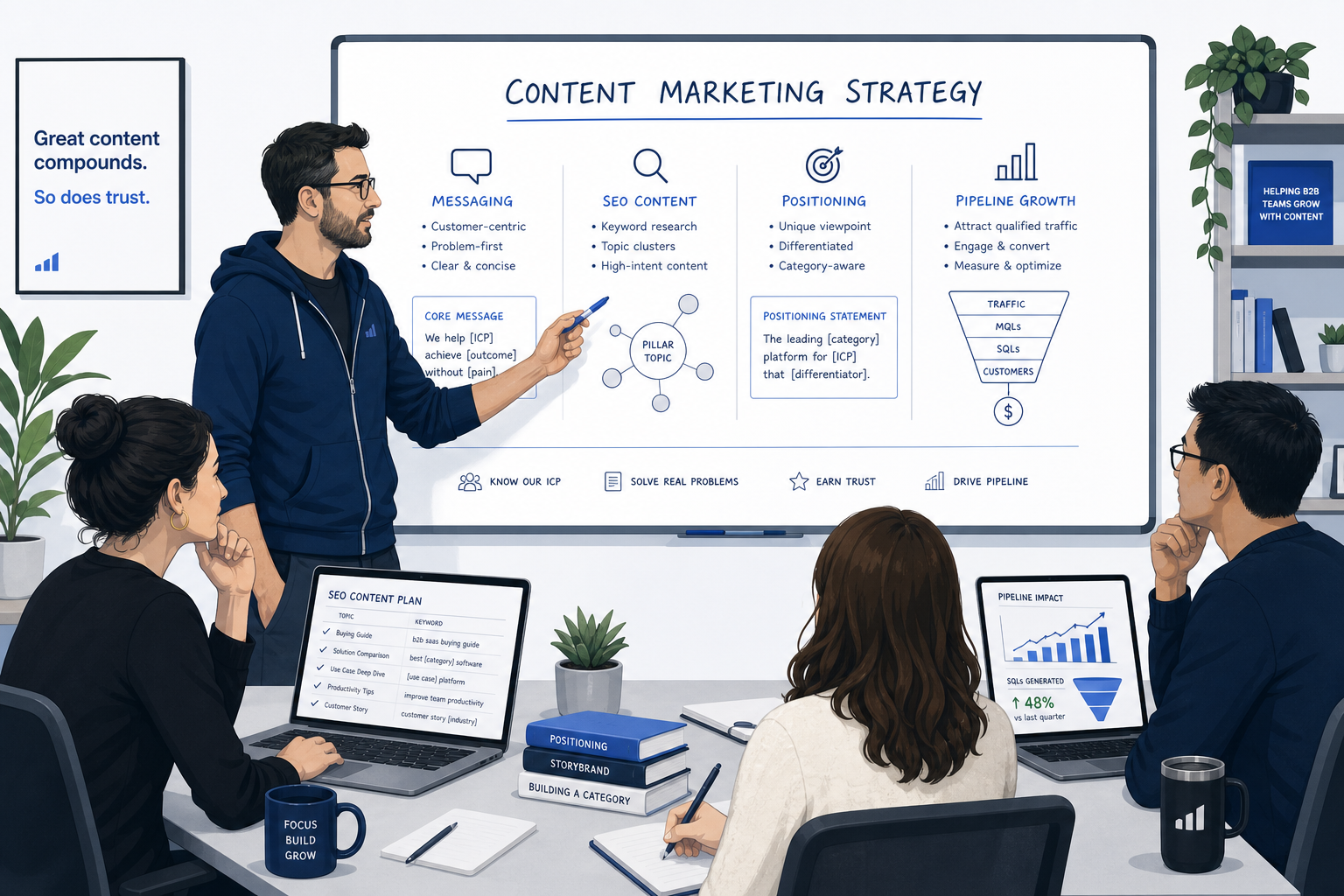
Most SaaS content programs get part of this right. They talk about features, SEO, keyword research, and measurement. But they often miss the part that actually changes outcomes for software companies: content performs best when it is grounded in sharp product positioning and built for discovery, evaluation, and sales enablement together.
That is where Rampkit's B2B SaaS content marketing service approaches the problem differently. Instead of producing content for volume alone, we help B2B software companies turn complex product knowledge into differentiated messaging and commercially useful content, without forcing founders to become full-time content managers.
What a B2B Content Marketing Strategy Actually Is
A b2b content marketing strategy is the system you use to decide:
- who you want to reach
- what they need to believe before buying
- which content assets will move them forward
- how those assets connect to pipeline and revenue
For SaaS companies, that system has to account for longer buying cycles, multiple stakeholders, technical evaluation, and product complexity.
A strategy is not a content calendar.
A strategy is the logic behind the calendar.
That logic should answer questions like:
Strategic Question | Why It Matters in B2B SaaS |
|---|---|
Who is the real buyer? | Founders often confuse user, champion, and budget owner |
What pain is urgent enough to buy for? | Features do not create demand on their own |
What alternatives are buyers comparing you against? | Competitors include incumbents, spreadsheets, agencies, and internal workflows |
What objections block deals? | Content should reduce friction before sales calls |
Which topics connect to product value? | Traffic without relevance rarely converts |
Why B2B SaaS Content Marketing Strategy Is Different From General B2B Content
A generic B2B approach is not enough for SaaS.
Software buying is more self-directed, comparison-heavy, and tied to recurring value. The content job is not just to attract attention. It is to shorten understanding time and increase buyer confidence.
"84% of B2B buyers told us they self-educate as much as they possibly can when evaluating software solutions." - Tourial SaaS Website Study
That matters more than most teams realize. Buyers do not read one blog post and book a demo. They build conviction across many touchpoints.
For SaaS, content usually has to serve all of these audiences:
- technical evaluators
- end users
- team leads
- economic buyers
- procurement or compliance stakeholders
And it often has to do that while explaining an abstract or technically dense product category.
What changes in SaaS specifically
1. Positioning matters more
If your product category is crowded, feature-level content will blend in. Strong strategy starts with a clear point of view and differentiated positioning.
2. Buyer intent is fragmented
Some prospects search problem-first terms. Others search competitor alternatives, integrations, workflows, or use cases. Your content has to cover that spread.
3. Sales cycles are longer
This increases the importance of mid- and bottom-funnel assets like comparison pages, case studies, implementation content, and sales enablement.
4. Retention and expansion matter
Unlike one-time purchase businesses, SaaS wins on compounding value. Good content also supports onboarding, adoption, and expansion.
The Core Framework for a High-Performing B2B SaaS Content Marketing Strategy
Here is the simplest way to think about strategy:
Positioning -> Buyer Intent -> Content Architecture -> Distribution -> Conversion -> Measurement
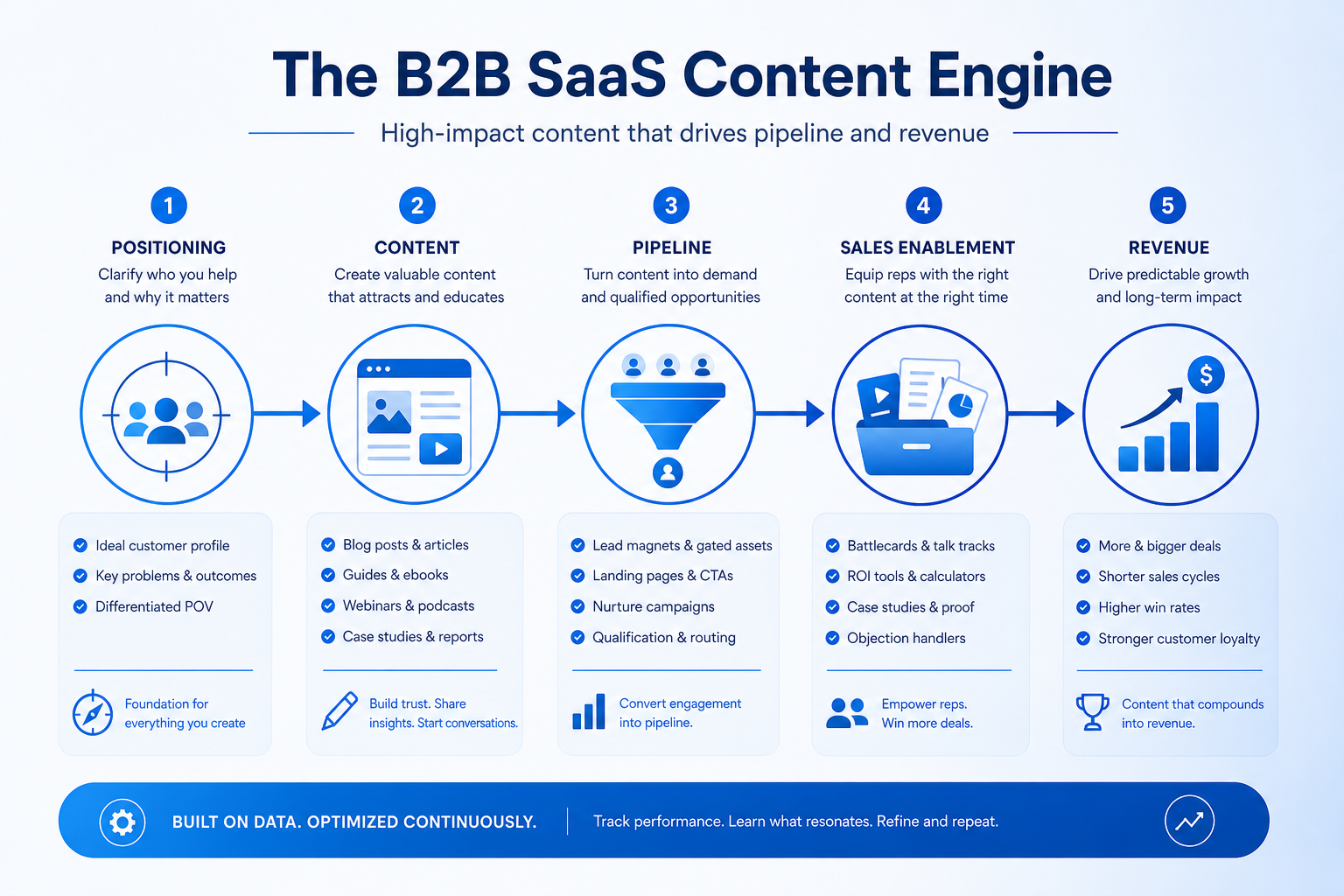
1. Positioning first, always
Most teams start with keyword research. That is too late.
If you do not know how to frame the product, differentiate it, and match messaging to buyer pain, keyword strategy becomes an efficiency exercise on top of weak foundations.
Before planning content, define:
- target segments
- buying triggers
- alternatives buyers replace
- product strengths that actually matter in deals
- claims you can credibly own
- language customers use to describe the problem
This is where senior product marketing work changes content quality dramatically. It is also where Rampkit tends to outperform generic agencies, freelancers, or AI-only workflows. Strong content comes from strong strategic inputs.
2. Map content to real buyer stages
A lot of content programs over-invest in awareness because it is easier to produce. But SaaS companies often need a more balanced asset mix.
A useful structure looks like this:
Buyer Stage | Buyer Questions | Best Content Types |
|---|---|---|
Discovery | What is this problem? How are teams solving it? | SEO blog posts, thought leadership, category explainers, educational guides |
Evaluation | Which approach is right? Which vendors fit my needs? | Comparison pages, alternative pages, use-case pages, expert frameworks, webinars |
Conversion | Why choose you now? Will this work for us? | Case studies, sales decks, one-pagers, ROI narratives, objection-handling content |
3. Build a content architecture, not a pile of posts
Strong strategy creates a connected system:
- pillar pages around core categories or use cases
- blog content around buyer questions and search intent
- landing pages for industries, personas, or workflows
- comparison pages for competitor and alternative searches
- proof assets for sales and conversion
That is the difference between “doing content” and building an engine.
The Biggest Content Gaps Most SaaS Teams Miss
When content is treated as publishing instead of product marketing, a few common gaps show up quickly.
They talk about features, but not enough about positioning
Feature-level content is easy to produce, but it does not fix weak product messaging. If the story is unclear, every stage of the journey becomes harder to move through.
If your homepage, category framing, and differentiation are fuzzy, content will underperform no matter how well optimized it is.
They emphasize traffic more than sales usefulness
A blog strategy is not enough. SaaS content should include:
- one-pagers
- battlecards
- decks
- case studies
- customer proof
- conversion pages
In other words, content should help both marketing and sales.
They do not go deep enough on technical products
For DevTools, AI, infrastructure, cybersecurity, data, and enterprise platforms, the hard part is not publishing. It is translating complexity into clear value without oversimplifying.
That requires product marketing judgment, not just writing ability.
They underplay founder bandwidth
Early-stage teams often know what should exist but cannot dedicate the time. A founder-friendly strategy has to minimize involvement, extract insight efficiently, and handle the heavy lifting asynchronously.
That is one of the biggest practical advantages of an embedded partner model like Rampkit: senior PMM thinking plus execution, without the overhead of a full-time hire.
How to Build Your B2B SaaS Content Marketing Strategy Step by Step
Step 1: Start with your commercial goals
Content should connect to a business objective.
Examples:
- increase qualified demo volume
- improve conversion on high-intent pages
- support a new category launch
- create sales assets for enterprise deals
- improve organic share in a strategic segment
- increase authority in a technical niche
This sounds obvious, but many teams skip it. They publish because “content is important,” not because a specific commercial bottleneck needs solving.
Step 2: Define the ICP and buying committee
Do not stop at “mid-market SaaS companies” or “engineering leaders.”
Go deeper:
- company size
- maturity stage
- existing stack
- team pain points
- risk profile
- internal blockers
- decision criteria
Then identify role-specific concerns.
Stakeholder | What They Care About |
|---|---|
Technical buyer | implementation, scalability, integrations, security |
Team lead | workflow fit, team adoption, operational efficiency |
Executive buyer | ROI, strategic value, speed, risk reduction |
Procurement / Ops | compliance, pricing clarity, process friction |
This is where many weak strategies fail. They write to a generic audience instead of a buying group.
Step 3: Clarify your narrative and messaging
Before creating a content roadmap, define:
- category you want to be associated with
- problem you solve best
- reason to believe
- why now
- why you instead of alternatives
This messaging should shape:
- homepage copy
- solution pages
- SEO content
- founder thought leadership
- case studies
- sales collateral
Without this layer, the content may be accurate but still interchangeable.
Step 4: Build topic clusters around buyer intent
Do not just target top-volume keywords.
Group content by intent:
Problem-aware topics
These capture buyers researching the problem space.
Examples:
- how to improve cloud cost visibility
- common GenAI deployment mistakes
- why enterprise teams struggle with model governance
Solution-aware topics
These capture buyers exploring approaches.
Examples:
- best cloud cost management tools
- observability platform alternatives
- AI evaluation frameworks for enterprise teams
Product-aware topics
These capture high-intent evaluation behavior.
Examples:
- competitor comparisons
- alternatives pages
- integration pages
- use-case pages
- migration guides
A lot of SaaS teams have a giant gap in the third category.
Step 5: Prioritize pages that influence revenue
If you only have limited bandwidth, publish in this order:
- Core website messaging and key solution pages
- High-intent bottom-funnel pages
- Case studies and proof assets
- Strategic SEO content
- Thought leadership and category creation content
This is one of the most important strategic shifts for lean teams. Bottom-funnel and conversion support often outperform broad traffic plays early.
Step 6: Connect content to conversion paths
Every content asset should lead somewhere sensible.
For example:
Content Type | Strong Next Step |
|---|---|
Educational blog post | related use-case page, template, newsletter, product explainer |
Comparison page | demo CTA, ROI conversation, technical deep dive |
Case study | industry page, relevant solution page, sales contact |
Thought leadership article | narrative page, webinar, category asset |
Most underperforming content fails here. It attracts attention but does not guide momentum.
The Content Types Every B2B SaaS Company Should Consider
SEO and AEO blog content
Search-led content still matters, but it has changed.
Winning content now needs to perform for both classic search and answer engines. That means clarity, depth, original framing, and commercially relevant intent matter more than keyword stuffing.
Use blog content for:
- category education
- problem framing
- buyer research queries
- expert point-of-view content
- integration and workflow education
Comparison and alternative pages
These are among the highest-intent assets in many SaaS categories.
They help you capture buyers already evaluating options and give your team a place to control the narrative.
A strong comparison page should include:
- who each tool is best for
- differences in approach
- strengths and tradeoffs
- ideal use cases
- proof or customer evidence
- clear CTA
Use-case and solution pages
These pages help buyers self-identify.
Instead of describing your product generically, show how it solves specific workflows, industries, or team needs.
Examples:
- for platform engineering teams
- for AI product teams
- for security-conscious enterprises
- for onboarding automation
- for customer support ops
Thought leadership
This is especially important when the market is crowded or new.
Thought leadership should not be founder diary content. It should articulate a sharp market perspective that increases authority and informs positioning.
Strong forms include:
- category critiques
- original frameworks
- strategic POV pieces
- opinionated breakdowns of market shifts
Sales enablement content
This is the biggest missed lever in many content programs.
Sales content includes:
- one-pagers
- pitch decks
- battlecards
- objection handling docs
- case studies
- customer stories
- executive summaries
For lean teams, combining product marketing and content execution here creates outsized leverage. It helps deals move, not just search rankings.
What Good Content Strategy Looks Like Across the Buyer Journey
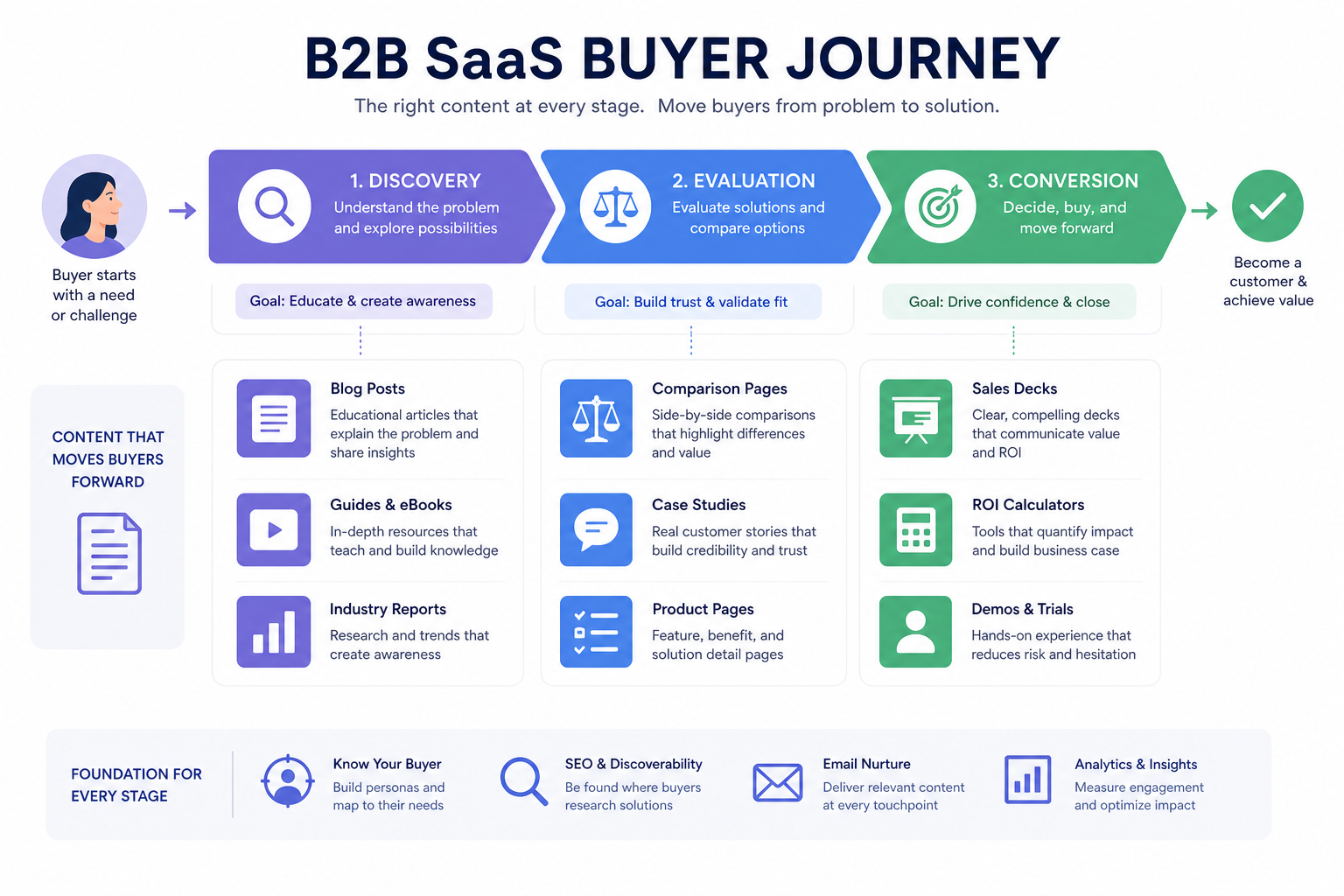
A useful content strategy for SaaS is rarely linear, but the journey framework still helps.
Discovery stage
The buyer is trying to understand the problem or evaluate possible approaches.
Best assets:
- SEO guides
- educational blogs
- category explainers
- founder or expert POV
- research-backed thought leadership
Goal:
- attract relevant attention
- shape the problem definition
- establish expertise
Evaluation stage
The buyer now knows the category and is comparing methods or vendors.
Best assets:
- comparison pages
- alternatives pages
- use-case pages
- webinars
- implementation explainers
- detailed solution content
Goal:
- reduce confusion
- differentiate your approach
- address objections before calls
Conversion stage
The buyer is validating risk and deciding whether your solution is credible.
Best assets:
- case studies
- customer proof
- ROI framing
- security or implementation docs
- decks and one-pagers
- pricing or packaging guidance
Goal:
- create confidence
- reduce friction
- support deal progression
SEO Strategy Within a B2B SaaS Content Marketing Strategy
SEO is a distribution channel, not the strategy itself.
That distinction matters.
The best SEO programs in B2B SaaS are shaped by product positioning and commercial intent. They do not chase every possible topic. They focus on search spaces that connect to category authority and revenue relevance.
What to target
Prioritize these keyword buckets:
Keyword Bucket | Example Intent |
|---|---|
Category terms | define the market you want to win |
Pain-point terms | capture problem-aware buyers |
Workflow terms | connect product to practical use |
Comparison terms | intercept buyers evaluating options |
Alternative terms | capture competitor displacement |
Persona / industry terms | align to segmented use cases |
What to avoid
Be careful with topics that are:
- too broad
- unrelated to your product motion
- attractive in traffic but weak in buying relevance
- impossible to differentiate meaningfully
A lot of SaaS blogs become mini media sites that bring in readers who were never likely buyers.
Content Measurement: What to Track Beyond Traffic
This is where many content programs stop before the work becomes commercially useful.
Traffic matters. Rankings matter. But if you stop there, you are not measuring strategy.
Track content in layers.
Visibility metrics
- rankings
- impressions
- organic traffic
- share of voice
- branded search lift
Engagement metrics
- scroll depth
- return visits
- assisted conversions
- CTA click-through rate
- pathing to product or sales pages
Pipeline metrics
- demo requests from content journeys
- influenced opportunities
- pages viewed before conversion
- content used in closed-won journeys
- velocity impact on opportunities
Sales usefulness metrics
- assets used by sales
- comparison page influence
- case study usage
- objection-handling enablement
- feedback from reps
The best content strategy is not “just SEO” and not “just brand.” It creates measurable movement across pipeline and conversion.
A Lean Operating Model for Founders and Small Teams
One of the biggest challenges in SaaS content marketing is not knowing what to do. It is having the capacity to do it well.
Founders and lean marketers usually face one of these bad options:
Option | Common Problem |
|---|---|
Hire full-time senior PMM | expensive and slow for early-stage teams |
Use generic content agency | output is polished but shallow |
Hire freelance writers | execution varies and strategy is often missing |
Rely on AI alone | fast, but undifferentiated and often inaccurate |
This is exactly why embedded strategy-plus-execution models are gaining traction.
Rampkit is built for this gap. We bring senior product marketing depth without full-time headcount cost, develop briefs and messaging asynchronously, and turn that strategy into website copy, SEO/AEO content, thought leadership, and sales assets that actually support revenue.
That means less founder time, faster output, and stronger commercial alignment.
What a Practical 90-Day Plan Looks Like
If you want to build a stronger b2b content marketing strategy quickly, this is a sensible 90-day structure.
Days 1-30: Strategy and messaging foundation
Focus on:
- ICP refinement
- buyer journey analysis
- competitor positioning review
- messaging and narrative development
- content audit
- keyword and intent mapping
Deliverables:
- messaging framework
- content priorities
- topic clusters
- funnel gaps
- roadmap
Days 31-60: Core asset build
Focus on:
- homepage and solution page improvements
- comparison or alternative pages
- one or two case studies
- first bottom-funnel content assets
- first strategic SEO articles
Deliverables:
- stronger website conversion layer
- core evaluation assets
- first wave of search content
Days 61-90: Scale and optimize
Focus on:
- thought leadership content
- deeper SEO cluster development
- sales enablement assets
- internal linking and conversion paths
- reporting on assisted pipeline signals
Deliverables:
- stronger authority
- broader search coverage
- sales-supported content engine
Common Mistakes That Undermine SaaS Content Strategy
Publishing before positioning is clear
If you have not nailed the narrative, more content usually creates more noise.
Overweighting top-of-funnel content
Traffic feels productive, but bottom-funnel assets often have faster revenue impact.
Treating all audiences the same
Your technical evaluator and budget owner do not need the same message.
Measuring content in isolation
If content reporting is disconnected from pipeline, sales usage, and conversion, you will miss what matters.
Underinvesting in product marketing
For technical SaaS categories, strategic interpretation is the multiplier. Better PMM inputs produce better content outputs.
Final Verdict: The Best B2B SaaS Content Marketing Strategy Is Commercially Grounded
A strong b2b saas content marketing strategy is not a publishing habit.
It is a commercial system built on:
- clear positioning
- differentiated messaging
- buyer-intent content architecture
- full-journey asset coverage
- conversion logic
- revenue-aware measurement
That is what separates content that gets read from content that gets remembered, trusted, shared with internal stakeholders, and used in buying decisions.
For SaaS founders and lean teams, the challenge is rarely understanding this in theory. The challenge is executing it at a high level without hiring a full in-house product marketing and content team.
That is where Rampkit is designed to help.
We combine senior product marketing thinking with execution across SEO/AEO content, thought leadership, website messaging, case studies, and sales enablement. We work asynchronously, minimize founder lift, and build assets that support discovery, evaluation, and conversion, not just vanity metrics.
If you want content that does more than fill a blog, Rampkit's content marketing service is built to help turn your product story into pipeline.
Let's turn your content into pipeline.
Tell us what you are working on. No pitch deck, no pressure. We'll review the context and tell you honestly whether Rampkit makes sense for where you are.