Product Marketing for B2B SaaS Startups: How to Build a PMM Function Without Hiring One
A founder-friendly guide to product marketing for B2B SaaS teams that need stronger positioning, messaging, sales enablement, and buyer-stage content without hiring a full-time PMM.
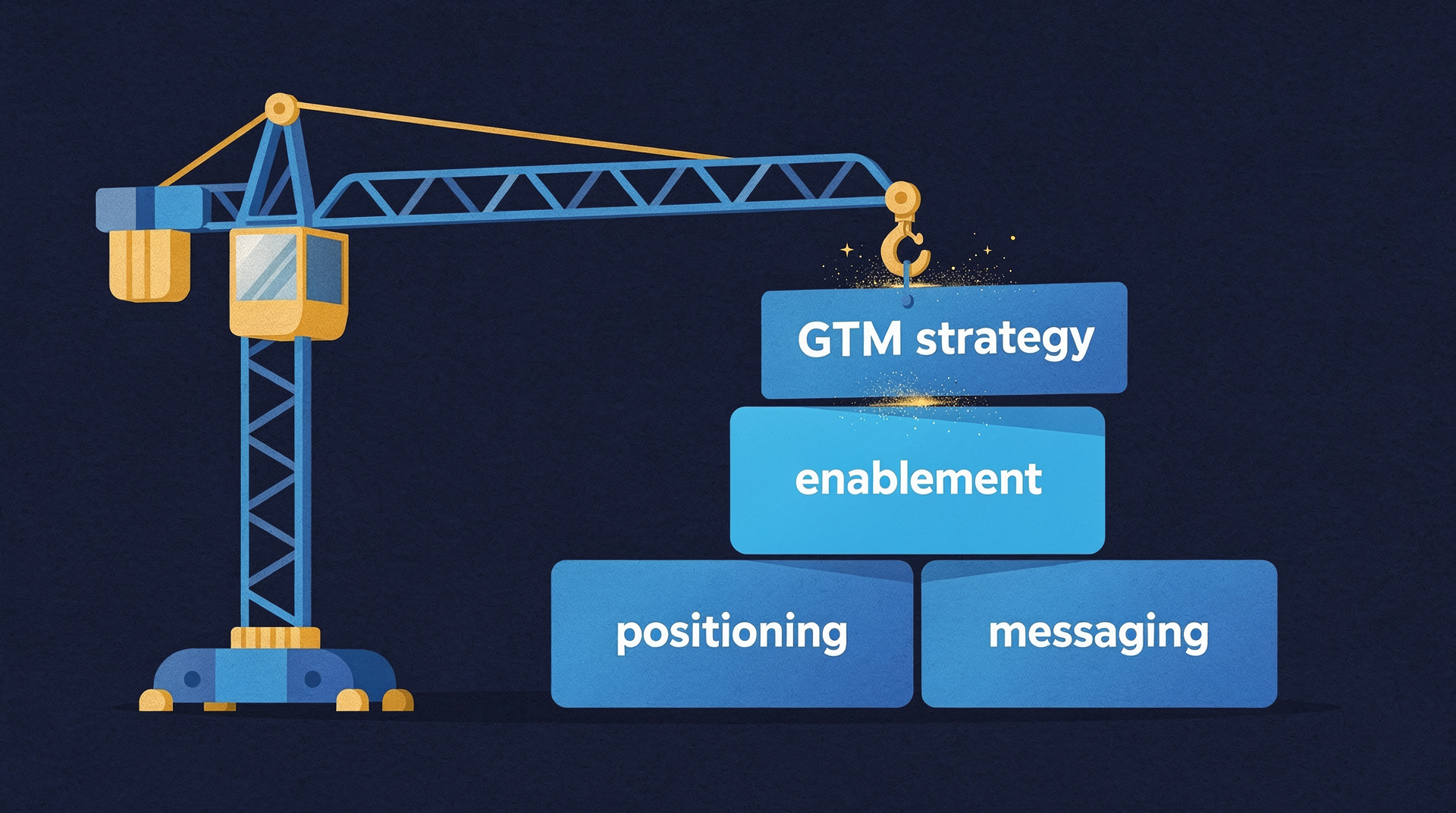
Great products lose when buyers cannot understand them quickly.
That is the product marketing problem most B2B SaaS teams run into. The homepage sounds vague. Sales keeps explaining the same basics. Launches get attention but do not change pipeline. Competitors with weaker products win mindshare because their story is easier to repeat.
Product marketing fixes the commercial gap between what the product can do and what the market believes it can do. It turns technical depth into clear positioning, sharp messaging, persuasive launch narratives, useful sales assets, and content that helps buyers make progress.
That matters more than ever in B2B software, where buyers research independently, compare alternatives quickly, and expect proof before they ever talk to sales.
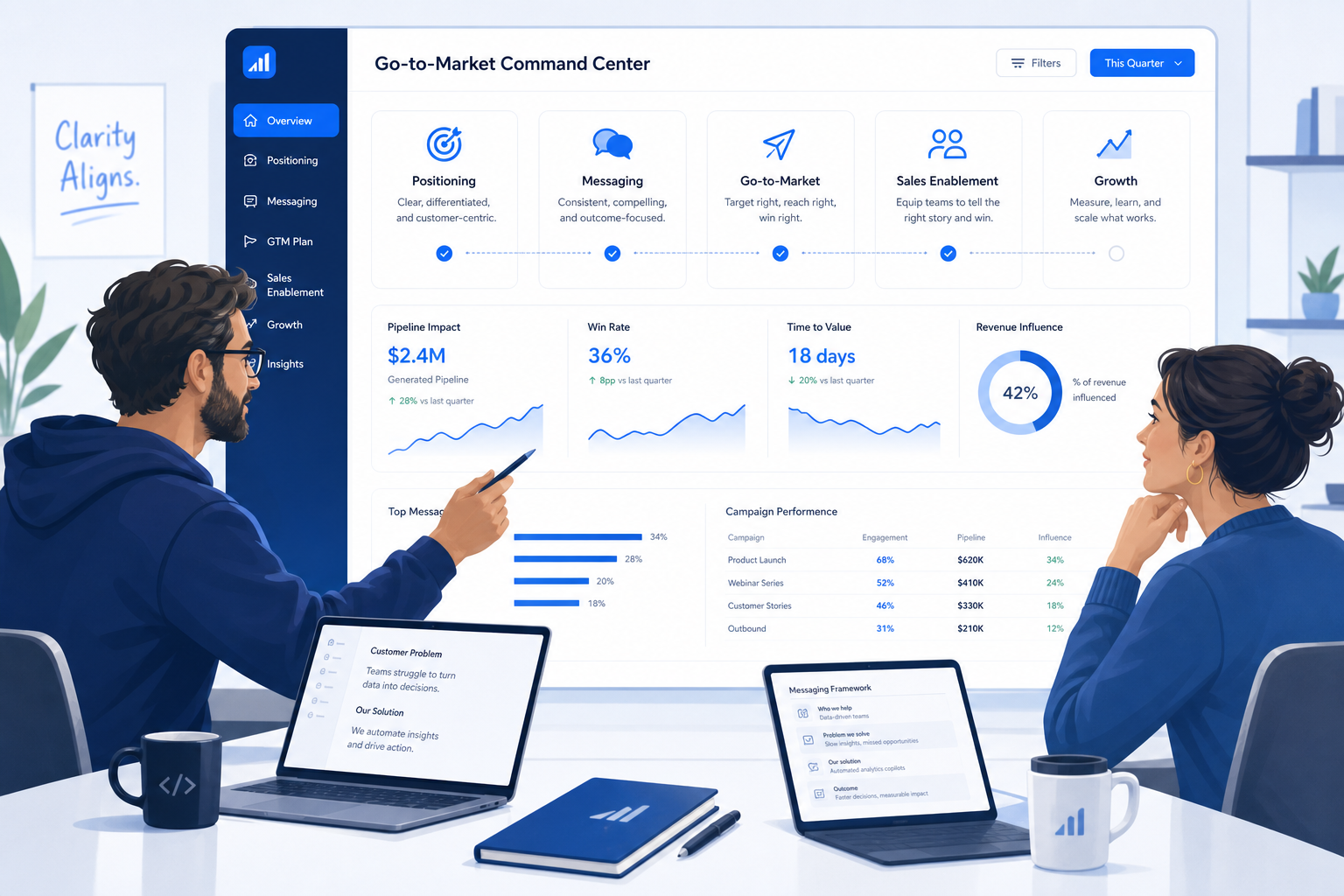
A strong product marketing function helps B2B SaaS companies answer the questions that drive pipeline and revenue:
- Who is this for?
- Why should they care?
- Why now?
- Why us instead of the alternatives?
- What proof makes the claim believable?
- What content and assets help buyers move from curiosity to decision?
Done well, product marketing gives your team the clarity, assets, and buyer understanding needed to drive adoption, revenue, and internal alignment.
"84% of B2B buyers prefer to gather information independently when evaluating software solutions." - Tourial SaaS Website Study
That tells the story. Buyers need better information before sales. Sales needs better material during evaluation. Product marketing sits in the middle and makes both work.
What product marketing actually is in B2B SaaS
Product marketing is the discipline responsible for bringing a product to market and making it understandable, desirable, and buyable.
In B2B SaaS, that usually includes:
- market and customer insight
- positioning
- messaging
- go-to-market strategy
- launch planning
- sales enablement
- customer proof
- product adoption support
- content for discovery, evaluation, and conversion
A useful way to think about it is this:
Function | Core question | Typical output |
|---|---|---|
Product | What are we building? | Features, roadmap, UX |
Marketing | How do we generate demand? | Campaigns, channels, traffic |
Sales | How do we convert demand? | Pipeline, demos, deals |
Product marketing | How do we make the product easy to understand, prefer, and buy? | Positioning, messaging, launches, sales assets, buyer content |
Product marketing is not separate from growth. It is what makes growth more efficient.
Without it, demand generation drives traffic that does not convert, launches create noise instead of momentum, and sales spends too much time explaining basics that should already be clear.
Why product marketing matters so much in B2B software
B2B SaaS is crowded. New categories emerge fast, feature parity happens quickly, and many teams sound almost identical in market.
That is why product marketing matters. It sharpens commercial clarity.
It creates differentiation in markets where products look similar
Many SaaS companies talk in abstractions:
- faster workflows
- AI-powered automation
- better collaboration
- enterprise-grade security
- scalable infrastructure
Those phrases are not positioning. They are category wallpaper.
Real product marketing defines:
- the buyer
- the problem
- the cost of the current approach
- the specific value your product creates
- the proof that you can deliver it
- the context where you win best
This is especially important in DevTools, infrastructure, AI platforms, and enterprise software, where the product may be technically impressive but difficult for buyers to evaluate quickly.
It improves conversion across the buyer journey
Product marketing does not just support the homepage. It improves performance at multiple stages:
Buyer stage | Product marketing impact |
|---|---|
Discovery | Clear narratives, SEO content, category framing |
Consideration | Use cases, competitor comparisons, proof points |
Evaluation | Sales decks, one-pagers, objection handling, demos |
Decision | Case studies, ROI logic, implementation confidence |
Adoption | Onboarding messaging, feature education, expansion narratives |
It aligns internal teams around one market truth
When product, marketing, sales, and leadership are misaligned, the company sends mixed signals.
Common symptoms include:
- the website says one thing, sales says another
- product launches without customer-facing clarity
- campaign messaging overpromises and onboarding underdelivers
- the founder is the only person who can explain the product well
Strong product marketing solves this by giving the company a shared narrative, common language, and reusable proof.
The core pillars of product marketing in B2B SaaS
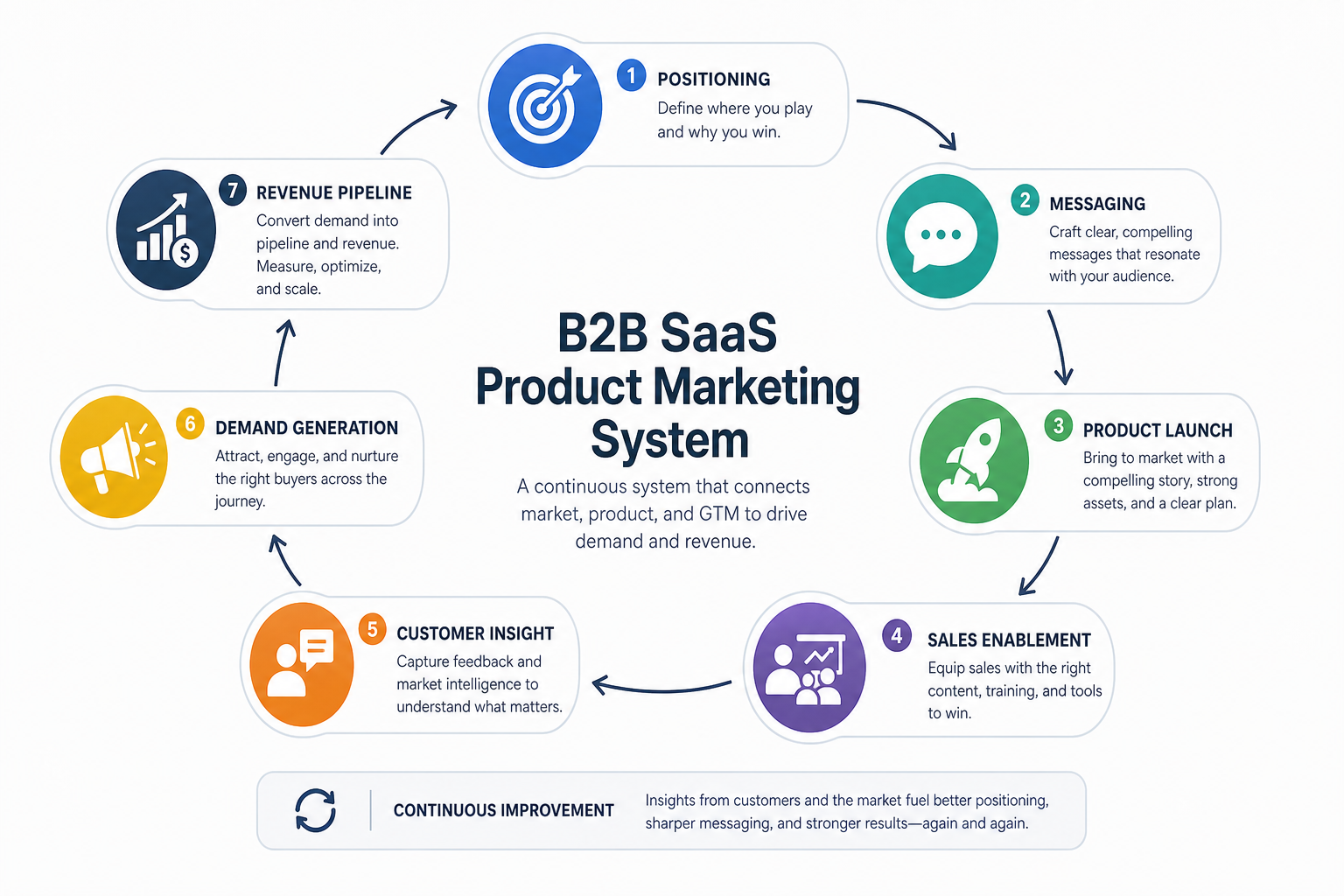
1. Customer and market insight
Every good product marketing system starts here.
You cannot position well if you do not understand:
- who buys
- who influences
- who uses
- what triggers the search
- what alternatives they compare
- what language they use
- what objections slow deals down
For B2B SaaS, customer insight should come from multiple sources:
- founder and sales interviews
- win/loss analysis
- call recordings
- demo notes
- support tickets
- customer interviews
- review sites
- competitor analysis
- search behavior
The goal is not just to collect opinions. The goal is to find patterns in pain, urgency, desired outcomes, and buying criteria.
Questions product marketers should answer
- What problem is painful enough to justify change?
- Who feels that pain most directly?
- What happens if they do nothing?
- What alternatives are they using now?
- What language do they use naturally?
- What do buyers misunderstand about the category?
- What proof reduces risk in the sales process?
This is where many teams skip ahead too fast. They start writing messaging before they understand the market deeply enough.
2. Positioning
Positioning is the strategic choice of how your product should be understood in the market.
It is not a tagline. It is not a homepage headline. It is the underlying commercial argument.
Good positioning answers:
- who the product is for
- what category it competes in
- what unique value it delivers
- why it is a better fit than alternatives
- when it is the right choice
A practical positioning framework for B2B SaaS looks like this:
Element | What it defines |
|---|---|
ICP | The specific company and buyer profile |
Problem | The important pain or inefficiency |
Category | The mental bucket buyers place you in |
Differentiator | The meaningful reason you are distinct |
Value | The business outcome you enable |
Proof | Evidence that your claim is credible |
Example positioning logic
A weak version: “An AI-native data platform for modern teams.”
A stronger version: “For enterprise data teams struggling to govern GenAI usage safely, our platform gives them policy-based control and traceability across tools, so they can unlock internal AI adoption without security and compliance risk.”
The second version does real work. It defines the audience, the problem, the value, and the reason this matters now.
3. Messaging
If positioning is the strategy, messaging is how that strategy gets expressed.
Messaging translates market insight into usable communication for:
- website copy
- product pages
- pitch decks
- outbound
- launch assets
- sales collateral
- blog content
- case studies
- demos
A good messaging system usually includes:
- value proposition
- headline and subheadline options
- persona-specific messages
- pain point statements
- outcome statements
- proof points
- objection responses
- competitor framing
- use case narratives
The test for strong messaging
Strong messaging should be:
- specific
- differentiated
- credible
- easy to repeat
- adaptable across channels
- relevant to buying decisions
If your team cannot explain the product clearly in one sentence, two paragraphs, and a five-minute talk track, messaging still needs work.
4. Go-to-market strategy
Go-to-market is the plan for how the product reaches the right buyers with the right story through the right channels.
In B2B SaaS, GTM is often treated too narrowly as launch planning. In reality, it should connect:
- ICP and segmentation
- message hierarchy
- pricing and packaging context
- sales motion
- self-serve vs assisted conversion
- channel strategy
- enablement needs
- success metrics
A simple GTM planning table:
GTM component | Key decision |
|---|---|
Audience | Which segment matters most now? |
Problem priority | Which pain point has the highest urgency? |
Motion | PLG, sales-led, hybrid, partner-led |
Channel | Search, outbound, partner, community, content, paid |
Asset set | What must exist before launch or scale? |
Conversion path | What is the next step: trial, demo, contact, workshop? |
Success metric | Activation, SQLs, pipeline, win rate, expansion |
For early-stage teams, one of the biggest mistakes is trying to serve too many segments with one generalized story. Product marketing should force sharper choices.
5. Product launches
Launches are often treated as announcements. That is incomplete.
A good B2B SaaS launch is not just “we shipped a feature.” It is a coordinated market event that answers:
- who this matters to
- what changed
- why it matters commercially
- what action the audience should take next
Launches can include:
- new products
- major features
- pricing changes
- category repositioning
- integrations
- market expansion
- packaging updates
- strategic partnerships
A practical product launch checklist
Phase | Product marketing role |
|---|---|
Pre-launch | audience definition, messaging, narrative, internal alignment |
Launch prep | landing pages, announcements, decks, enablement, proof |
Launch week | cross-channel execution, demos, outbound support |
Post-launch | feedback capture, sales adoption, content reuse, performance review |
Launches fail when internal teams understand the product better than the market does. Product marketing closes that gap.
6. Sales enablement
This is one of the most commercially important parts of product marketing.
Sales enablement is not about creating documents for the sake of it. It is about helping sales move deals forward faster and with more confidence.
That means building assets tied to real friction in the sales cycle:
- one-pagers
- pitch decks
- battle cards
- competitor comparisons
- case studies
- objection handling docs
- ROI narratives
- implementation guides
- customer story slides
- industry-specific talk tracks
What good sales enablement looks like
Asset | Purpose |
|---|---|
One-pager | Fast explanation for prospects and internal teams |
Deck | Structured narrative for demos and meetings |
Battle card | Competitive framing and objection handling |
Case study | Proof and transfer of trust |
ROI sheet | Business case support |
Use-case brief | Relevance for specific personas or industries |
The important point: enablement should be built from real sales conversations, not guesswork.
This is also where Rampkit's sales collateral service is especially valuable. Lean SaaS teams often need senior PMM thinking, but they do not have the budget or urgency bandwidth for a full-time hire. They need someone who can diagnose messaging gaps, build the brief, create the asset, and tie it back to revenue conversations. That is strategy and execution together, not strategy in a slide deck and execution left to someone else.
7. Content as product marketing infrastructure
Content marketing is often framed too generally.
For B2B SaaS, content is not just an awareness channel. It is part of product marketing infrastructure.
It helps buyers:
- understand the category
- frame the problem
- compare alternatives
- validate technical claims
- reduce risk
- justify purchase internally
That means the best content strategy is not just top-of-funnel blog volume. It is a buyer-journey system built around commercial questions.
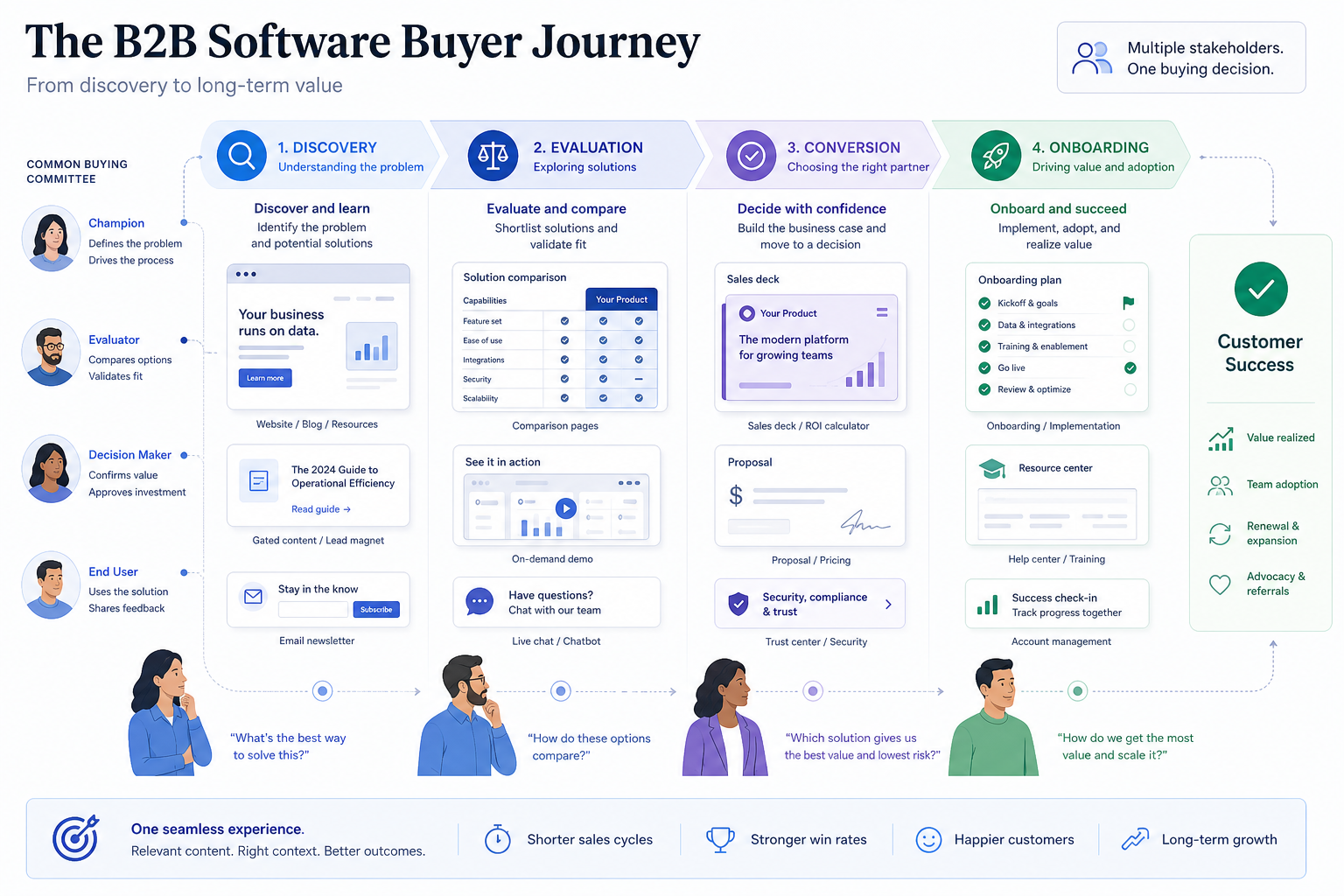
Content by stage of the journey
Stage | Content type | Goal |
|---|---|---|
Discovery | educational SEO articles, category explainers, thought leadership | create awareness and shape understanding |
Evaluation | comparison pages, use-case pages, product explainers, webinars | help buyers assess fit |
Conversion | case studies, one-pagers, decks, implementation content | reduce decision friction |
Adoption | feature education, onboarding guides, success content | support retention and expansion |
This is where strong product marketing and strong SEO meet.
A founder-friendly content partner should not just ask what keywords you want to rank for. They should understand what your buyers need to believe at each stage, then build assets around those decisions.
That is a major difference between generic content production and commercially useful product marketing content.
The relationship between product marketing and demand generation
This is where many SaaS companies create avoidable friction.
Demand generation without product marketing creates traffic without clarity.
Product marketing without demand generation creates strategy without reach.
The best growth systems connect the two.
How they work together
Product marketing | Demand generation |
|---|---|
Defines the story | Distributes the story |
Sharpens differentiation | Brings the audience |
Creates conversion assets | Creates traffic and engagement |
Supports sales conversations | Creates pipeline opportunities |
Improves buyer understanding | Scales buyer touchpoints |
If paid, SEO, email, or outbound is underperforming, the problem is not always the channel. Often the message is too vague, too generic, or too disconnected from buyer pain.
That is why technical founders frequently feel frustrated after hiring broad marketing support. The execution may be competent, but if the strategic product story is weak, the campaign ceiling stays low.
Product marketing for technical founders
Technical founders usually understand the product better than anyone else in the company. That is a strength, but it can also create communication risk.
Common founder-level challenges include:
- using internal language instead of buyer language
- explaining the architecture instead of the outcome
- assuming category understanding that buyers do not have
- overloading the story with too many capabilities
- struggling to simplify without losing technical credibility
Good product marketing does not “dumb down” a technical product. It translates it.
What technical audiences still need
Even sophisticated buyers want clarity on:
- what problem the product solves
- how it fits into their stack or workflow
- what the implementation burden is
- what risk it reduces or value it creates
- why it is better than maintaining the status quo
This is especially relevant in infrastructure, cybersecurity, AI tooling, developer platforms, and enterprise systems where the product can be powerful but hard to message.
A senior PMM partner can help founders externalize what is in their head, structure it for market relevance, and turn it into scalable content and sales assets without requiring endless founder meetings.
That is one reason Rampkit's product marketing content service works well for lean teams. The value is not just content output. It is reducing founder dependency while preserving strategic accuracy.
A practical product marketing framework for B2B SaaS teams
Here is a simple model to organize the function.
Stage 1: Diagnose
Before creating assets, identify the gaps.
Look at:
- homepage clarity
- sales objections
- win/loss reasons
- launch performance
- content-to-pipeline connection
- competitor confusion
- demo consistency
Diagnostic questions
- Can the team explain the product consistently?
- Does the website clearly tell the right buyer why this matters?
- Do sales and marketing use the same core narrative?
- Are comparison and use-case assets strong enough?
- Are launches producing meaningful follow-through?
- Is content helping evaluation, not just traffic?
Stage 2: Define
Build the strategic layer:
- ICP refinement
- segmentation
- category framing
- positioning
- messaging hierarchy
- proof points
- use-case prioritization
Stage 3: Deploy
Turn strategy into operating assets:
- homepage and product pages
- use-case and industry pages
- comparison pages
- launch narratives
- pitch decks
- one-pagers
- battle cards
- case studies
- SEO and AEO content
- thought leadership
Stage 4: Measure
Track commercial outcomes, not vanity signals.
Better metrics include:
Area | Useful metric |
|---|---|
Website messaging | conversion rate to demo or trial |
Sales enablement | sales usage and deal influence |
Launches | pipeline impact, qualified interest, adoption |
Content | influenced pipeline, assisted conversions, organic demos |
Positioning | win rate improvement, objection reduction, message recall |
Adoption | activation, feature uptake, expansion readiness |
What a high-performing product marketing operating system looks like
A mature B2B SaaS product marketing motion does not rely on random acts of content or one-off launches.
It looks more like this:
Layer | Outcome |
|---|---|
Insight | clear understanding of buyers and market dynamics |
Positioning | focused differentiation and category logic |
Messaging | repeatable story across web, sales, and content |
Content | assets mapped to discovery, evaluation, and conversion |
Enablement | sales confidence and reduced friction in deals |
Launches | coordinated release communication with commercial relevance |
Measurement | revenue-tied feedback loop |
This is why product marketing should not sit at the edge of the org. It should sit close to revenue.
In-house hire, agency, freelancer, AI, or embedded partner?
For many SaaS teams, the real question is not whether product marketing matters. It is how to resource it well.
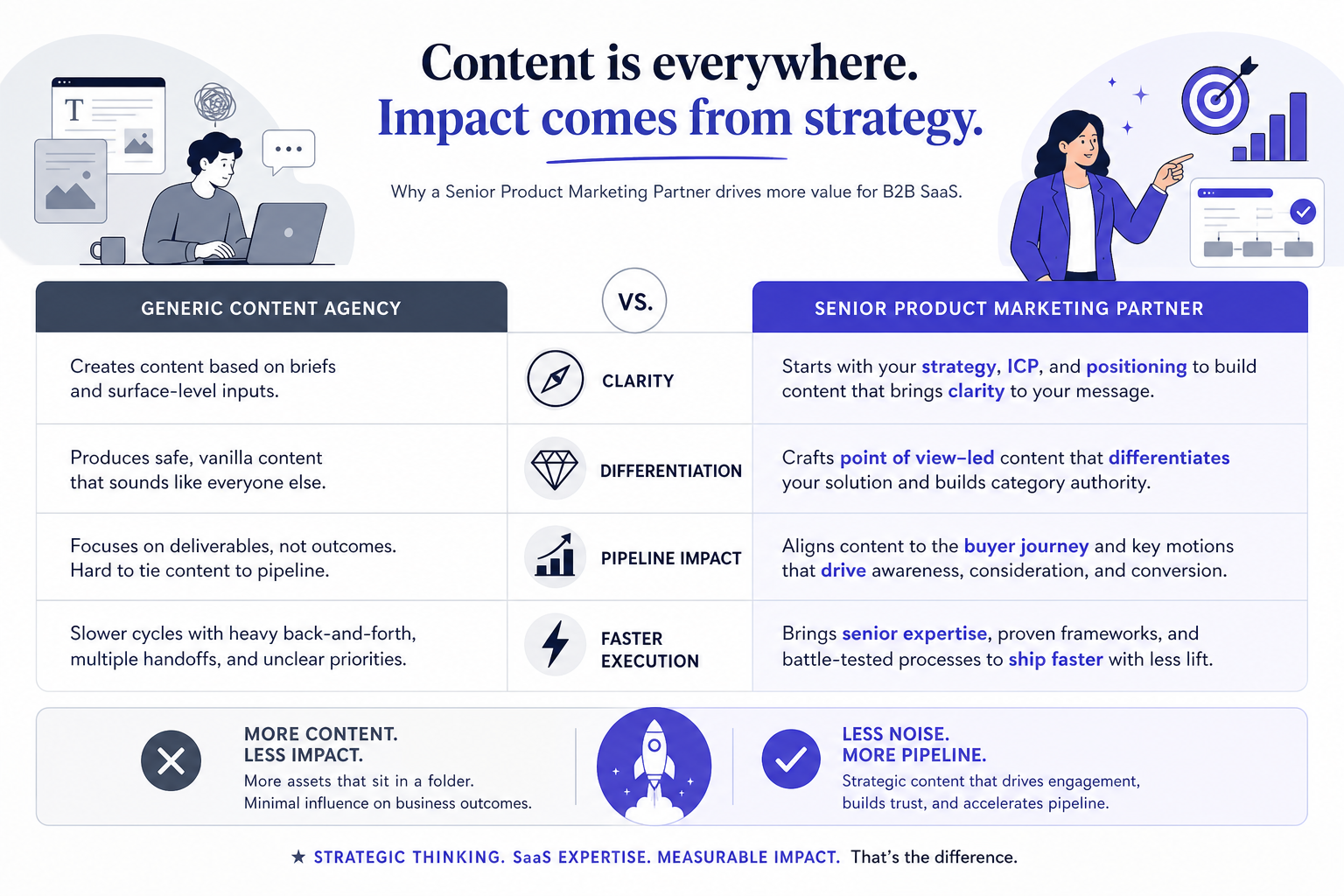
Option | Strength | Limitation |
|---|---|---|
Full-time PMM hire | deep ownership | expensive, slower to hire |
Generic agency | production capacity | often weak on technical positioning |
Freelancer | flexible and focused | may lack strategic breadth or enablement depth |
AI-only workflow | speed and low cost | weak judgment, generic output, no market synthesis |
Embedded senior partner | strategy plus execution, faster ramp, lower overhead | depends on quality of partner |
This is exactly where Rampkit's product marketing content service fits.
Rampkit helps B2B software companies get senior-level product marketing and content execution without the headcount cost of a full-time PMM. That matters for founders and lean teams that need:
- sharper differentiation
- better website messaging
- stronger product and sales content
- SEO and AEO content tied to buyer intent
- launch support
- sales enablement assets
- minimal coordination burden
- commercially useful output, not just content volume
The value is not generic writing. It is the combination of strategic product marketing depth and execution across the full buyer journey.
How to know if your company needs product marketing now
You likely need product marketing support if any of these are true:
- your product is strong, but prospects do not “get it” quickly
- the founder is still the main person explaining the value well
- your website gets traffic but weak conversion
- sales asks for more collateral or rewrites its own decks
- launches feel noisy but do not create sustained momentum
- content drives visits but little qualified pipeline
- competitors sound similar and buyers struggle to tell the difference
- expansion is harder because customers do not understand the broader value
Product marketing is especially urgent when the company is moving through any transition:
- seed to Series A
- founder-led sales to repeatable GTM
- single product to platform story
- niche audience to broader market
- technical messaging to executive buyer messaging
- outbound-led growth to content-supported demand generation
A founder-friendly way to implement product marketing
If you are a founder or lean marketing leader, keep the implementation simple.
First 30 days
- audit website, sales assets, and current message
- review calls, objections, and customer language
- define ICP and segment priorities
- identify the biggest clarity and conversion gaps
Next 30 days
- refine positioning and message hierarchy
- rewrite core website pages
- create one or two high-leverage sales assets
- map key content needed for evaluation and conversion
Next 60 days
- publish buyer-intent content
- build comparison and use-case pages
- support launch or campaign messaging
- measure conversion and sales usage
The goal is not to build a perfect framework in isolation. It is to improve market clarity fast enough that revenue teams feel the difference.
Conclusion
Product marketing is not optional polish for B2B SaaS companies. It is a core growth function.
It helps buyers understand what you do, why it matters, and why they should trust you. It helps sales move faster. It helps content perform better. It helps launches land. And it helps the whole company tell one coherent story.
For technical founders and lean software teams, the challenge is rarely recognizing the need. The challenge is getting senior-level product marketing done well without adding full-time headcount, founder bottlenecks, or fragmented execution.
That is where Rampkit's product marketing content service is built to help.
Rampkit combines senior product marketing thinking with hands-on execution across positioning, website messaging, SEO and AEO content, thought leadership, sales enablement, and buyer-stage assets. The work is tied to pipeline, revenue conversations, and differentiation, not vanity metrics. And the collaboration model is designed to keep founder lift low while still producing tailored, high-conviction output.
If your product is complex, your market is crowded, and your team needs sharper messaging that actually supports growth, Rampkit's product marketing content service is the right next move.
Let's turn your content into pipeline.
Tell us what you are working on. No pitch deck, no pressure. We'll review the context and tell you honestly whether Rampkit makes sense for where you are.