Product Positioning for B2B SaaS: How to Position Your Product So Buyers Choose You
A practical guide to product positioning for B2B SaaS teams, showing how sharper market clarity improves messaging, content, sales conversations, and pipeline.

Product positioning is not a brand exercise you do once for a slide deck. For B2B software companies, it is the foundation of smarter marketing, sharper messaging, better sales conversations, and stronger pipeline performance.
If you are a technical founder, an early-stage SaaS team, or a lean marketing function trying to explain a complex product to the right buyers, weak positioning creates expensive problems fast. Your homepage sounds generic. Your content attracts the wrong traffic. Sales decks over-explain the product but under-sell the value. And your team starts competing on features or price because the market does not clearly understand why you are different.
That is where strong product positioning changes the game. It helps you define who your product is for, what category you should own, what problem you solve best, and why your solution is meaningfully different from the alternatives.
At Rampkit's SaaS positioning and messaging service, we see this constantly with DevTools, AI products, infrastructure platforms, and enterprise SaaS teams. The technical depth is real. The product is often strong. But the market story is fuzzy. Smart positioning closes that gap by turning complex product knowledge into differentiated messaging and revenue-oriented content across discovery, evaluation, and conversion.
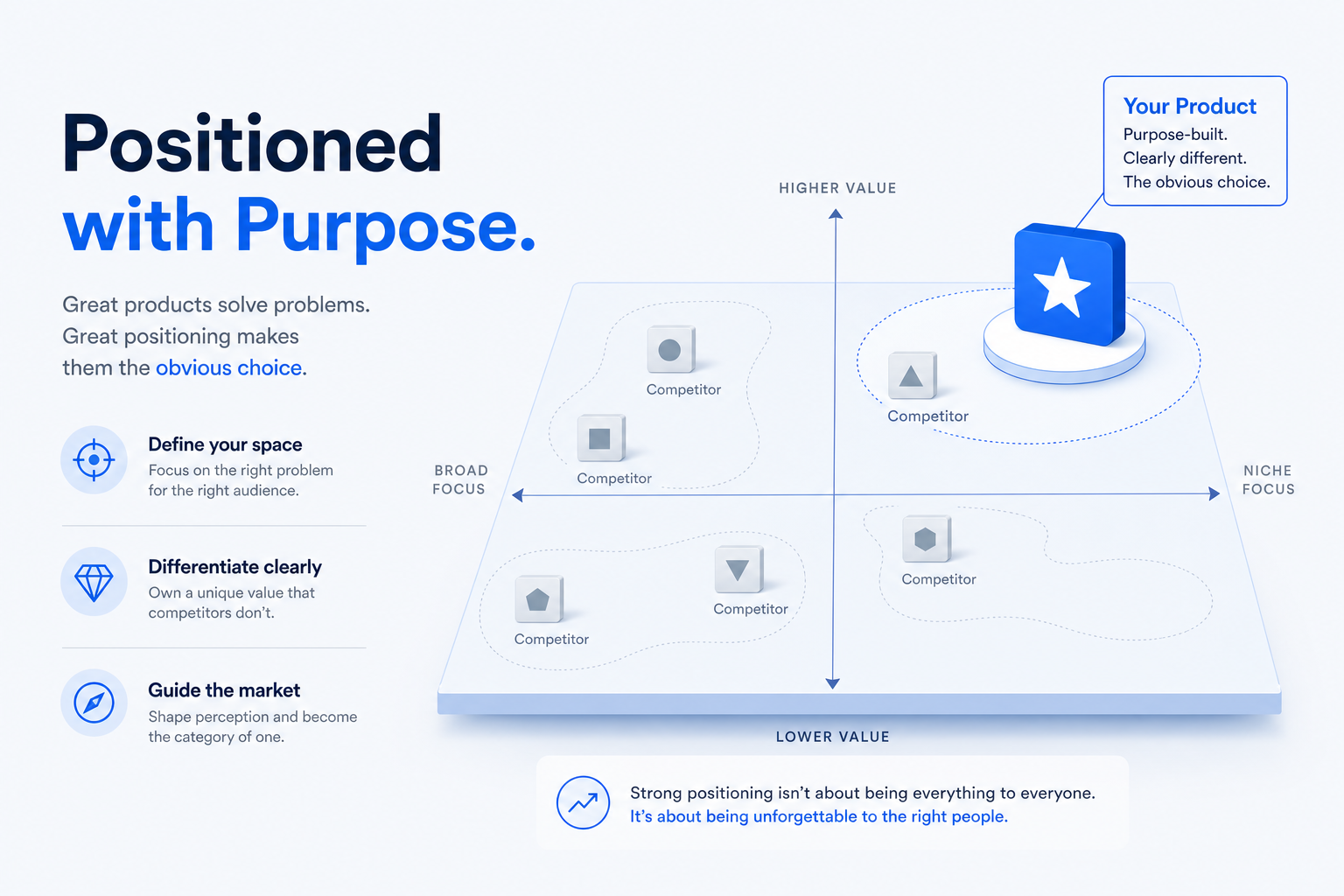
What Is Product Positioning?
Product positioning is the strategic process of defining how your product should be understood in the mind of a specific buyer compared with competing options.
That sounds simple, but it does a lot of work.
Good product positioning answers six core questions:
- Who is this for?
- What problem does it solve?
- What category does it belong to?
- What makes it different?
- Why should the buyer believe you?
- Why does that difference matter commercially?
This is why product positioning and marketing execution are closely linked. Positioning defines the strategic truth. Marketing translates that truth into messaging, content, campaigns, pages, decks, proof points, and sales enablement.
Product positioning vs messaging vs value proposition
These terms are often used interchangeably, but they are not the same.
Term | What it does | Main purpose |
|---|---|---|
Product positioning | Defines the product's place in the market | Strategic direction |
Messaging | Turns positioning into audience-specific language | Communication |
Value proposition | States the core benefit and outcome | Buyer relevance |
Differentiation | Explains what sets you apart | Competitive advantage |
Brand positioning | Frames the wider company identity | Market perception |
A useful way to think about it:
- Positioning is the strategic backbone.
- Messaging is how you say it.
- Content marketing is how you distribute and reinforce it.
- Sales enablement is how your GTM team uses it to win deals.
Why Product Positioning Matters More Than Ever
In crowded SaaS markets, being good is not enough. Buyers need to understand why you are the right choice quickly.
That is especially true in technical categories where products can sound similar on the surface. If everyone says they are scalable, AI-powered, secure, and easy to use, then nobody is differentiated.
As B2B offerings become more commoditized, business buyers increasingly rely on subjective and personal value drivers, according to Harvard Business Review's The B2B Elements of Value, authored by Bain partners Eric Almquist, Jamie Cleghorn, and Lori Sherer.
When positioning is weak, you usually see the same symptoms:
- Website copy that sounds interchangeable with competitors
- Content that generates traffic but not qualified demand
- Sales calls that start with long explanations and technical backstory
- Feature-heavy messaging with no category clarity
- Pipeline friction because buyers do not grasp the business value fast enough
When positioning is strong, the opposite happens:
- Buyers self-identify faster
- Marketing becomes more targeted
- Sales conversations become shorter and more persuasive
- Product differentiation becomes clearer
- Your team can create consistent content across the funnel
For founders and lean teams, this matters even more because every campaign, page, and asset has to pull its weight. You do not have room for vague messaging.
The Real Goal of Product Positioning
The point of product positioning is not just to sound better.
The real goal is to create market understanding that improves commercial outcomes.
That includes:
- Better-fit inbound traffic
- Higher homepage and landing page conversion
- Stronger paid and organic campaign performance
- Better sales call quality
- More effective objection handling
- Faster buyer comprehension
- Higher win rates in the right segment
This is where many positioning efforts stop too early. They treat positioning as a branding concept, but do not connect it deeply enough to revenue mechanics.
For SaaS companies, especially in early stage growth, product positioning should directly support:
- Demand generation
- Sales enablement
- Category creation or reframing
- SEO and AEO strategy
- Pipeline efficiency
That is also why Rampkit's positioning and messaging approach is different from a typical content agency or freelance writer. Strong product positioning is not an isolated deliverable. It is the source material for high-performing website messaging, thought leadership, SEO content, comparison pages, one-pagers, sales decks, case studies, and buyer-stage content.
The Core Components of Strong Product Positioning
A strong positioning strategy usually includes the following components.
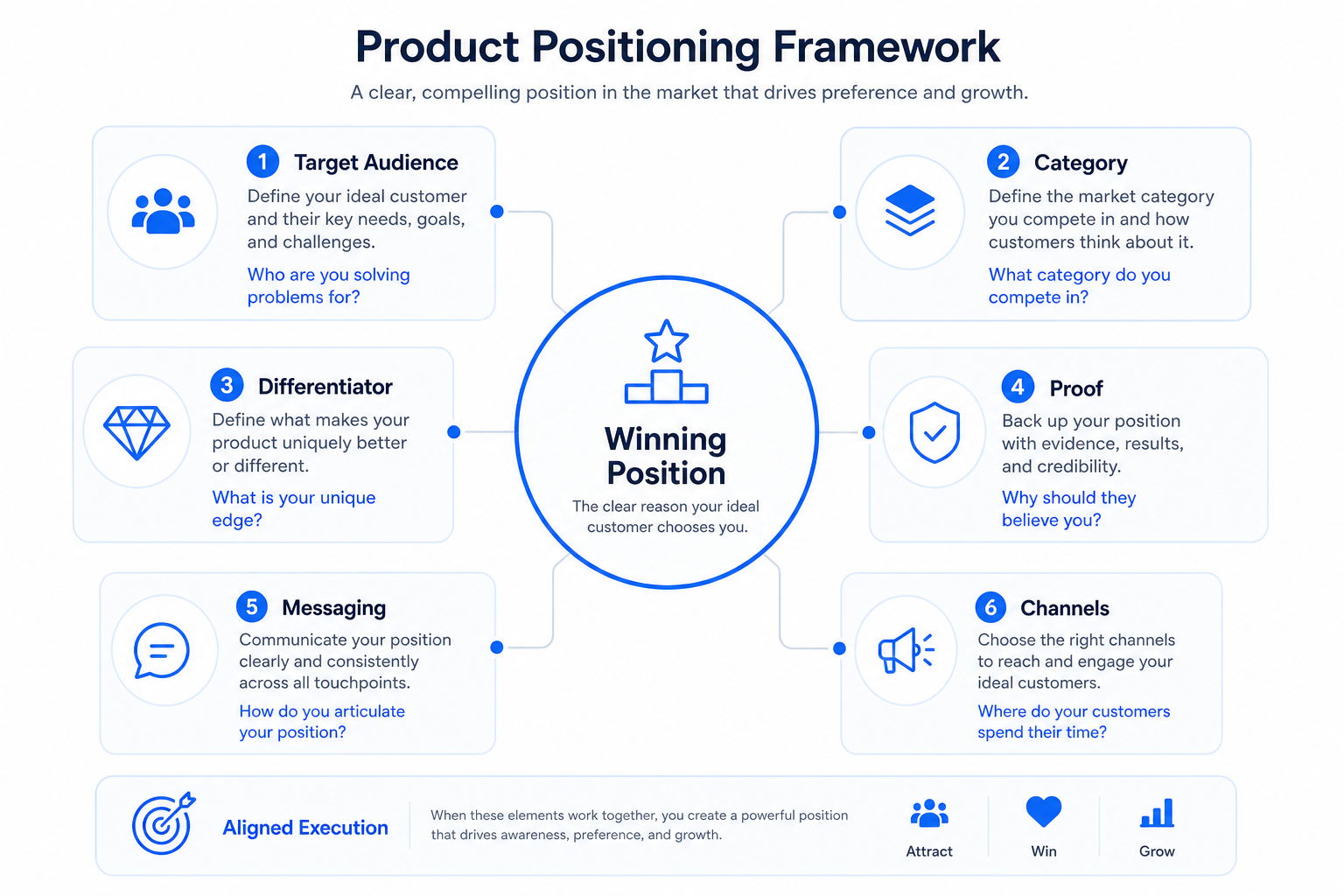
1. Target audience
This is not “companies that need better software.”
It is the specific buyer or buying team, with enough clarity to guide strategy. That may include:
- Company size
- Industry
- Technical maturity
- Team function
- Trigger events
- Current alternatives
- Pain severity
- Buying urgency
For example:
- Seed to Series A engineering-led startups
- Platform teams at mid-market SaaS companies
- RevOps leaders at enterprise B2B firms
- CTOs evaluating AI infrastructure tools
2. Market category
Buyers need context. They compare new solutions through known frames of reference.
If your category is unclear, your product feels harder to understand and riskier to buy.
Examples:
- Developer observability platform
- Customer data infrastructure tool
- AI evaluation platform
- Enterprise knowledge workflow software
Sometimes the smartest move is to position within an existing category. Sometimes it is to redefine or narrow the category. That decision matters.
3. Primary differentiator
This is the central reason your product is distinct.
It should not be a long list of features. It should be a meaningful wedge.
Examples:
- Built specifically for developer workflows rather than generic analytics teams
- Faster deployment and lower implementation overhead
- Better governance and control for enterprise AI use cases
- More actionable workflows, not just reporting dashboards
4. Reason to believe
Buyers need proof.
This can include:
- Product architecture
- Technical design
- Customer outcomes
- Unique method or model
- Integration depth
- Security posture
- Expertise of the founding team
- Customer logos or case studies
5. Payoff
This is the business relevance of the positioning.
A differentiator only matters if it leads to an outcome buyers care about, such as:
- Reduced time to value
- Lower operational complexity
- Faster team adoption
- Better reliability
- Lower total cost
- Better compliance
- More pipeline efficiency
A Practical Product Positioning Statement Template
A simple template can help organize your thinking:
For [target audience], who need [specific need or problem], our product is the [category] that [core differentiator], because [reason to believe].
Here is a SaaS example:
For platform engineering teams at fast-growing B2B SaaS companies who need to manage internal developer workflows without operational overhead, our product is a developer operations platform that automates environment provisioning and governance, because it integrates directly into existing engineering workflows and reduces manual setup time by design.
This is not customer-facing copy. It is a strategy tool. Once this is clear, your homepage, campaign messaging, and content become much easier to write.
The 7 Most Common Product Positioning Strategies
Most products lean on one or more classic positioning approaches. The strongest strategies usually combine a clear primary angle with relevant proof.
1. Benefit-based positioning
You lead with the result or outcome.
Example: faster deployments, fewer manual tasks, better visibility.
Best when buyers care most about business impact.
2. Audience-specific positioning
You tailor the product around a defined user or team.
Example: built for platform engineers, not general IT teams.
Best when the market is broad and you need sharper relevance.
3. Category positioning
You define the frame buyers should use to understand you.
Example: not just analytics software, but a revenue intelligence platform.
Best when category clarity drives adoption.
4. Competitive positioning
You position against a known alternative.
Example: a modern, purpose-built alternative to legacy enterprise suites.
Best when you are entering an established market.
5. Quality or premium positioning
You emphasize trust, performance, reliability, or sophistication.
Example: enterprise-grade governance for AI systems.
Best when risk reduction is central to buying decisions.
6. Price positioning
You lead with affordability or better value.
Example: infrastructure cost savings without sacrificing performance.
Best when buyers are highly price-sensitive and value is obvious.
7. Use-case positioning
You anchor the product around a specific application.
Example: built for AI model evaluation in regulated environments.
Best when your use case is clearer than your category.
How to Build a Product Positioning Strategy Step by Step
For B2B SaaS teams, positioning has to move quickly from theory into decisions your website, sales team, and content can actually use.
Step 1: Start with buyer reality, not internal assumptions
Interview customers. Review sales calls. Analyze lost deals. Look at support tickets and onboarding friction.
You want to know:
- Why buyers buy
- Why they hesitate
- What alternatives they compare you to
- What language they use
- What value they expect
- What they misunderstand
For technical products, this step is essential because internal teams often overestimate how clearly the market understands the product.
Step 2: Map the competitive landscape
Create a simple matrix of competitors, adjacent tools, in-house alternatives, and the status quo.
Look at:
- Positioning language
- Homepage narrative
- Feature emphasis
- Pricing posture
- Proof structure
- Category claims
Your goal is not to copy them. It is to identify white space.
Questions to ask
- What claims are overused?
- What buyer problems are underserved?
- Where are competitors too broad?
- Where are they too technical?
- What value is not being articulated well?
Step 3: Identify the positioning wedge
This is the strategic angle you can credibly own.
A good wedge is:
- Specific
- Relevant
- Defensible
- Valuable
- Easy to understand
Weak wedge:
- “AI-powered platform for modern businesses”
Strong wedge:
- “The AI evaluation layer for enterprise teams that need governance, traceability, and model testing before production rollout”
Step 4: Pressure-test the category
If buyers cannot place your product quickly, they may not buy.
Ask:
- What category helps people understand us fastest?
- Does that category undersell our value?
- Should we refine, stretch, or redefine the category?
- Is the category credible to analysts, buyers, and search behavior?
This is also where SEO and positioning intersect. If your category is too abstract, search demand may be weak. If it is too broad, competition may be intense and relevance diluted.
Step 5: Turn strategy into a concise positioning statement
Use the framework above. Keep it simple. Avoid jargon.
Then create supporting layers:
- Value propositions
- Messaging pillars
- Objection handling
- Proof points
- Persona-specific angles
Step 6: Translate positioning into full-funnel assets
This is where many teams fail. They stop after the strategy doc.
Positioning only matters when it is operationalized across:
- Homepage copy
- Product pages
- Comparison pages
- Demo pages
- Sales decks
- One-pagers
- Battle cards
- SEO content
- Thought leadership
- Case studies
- Email nurture flows
This strategy-plus-execution gap is exactly why many early-stage teams use Rampkit's positioning and messaging service. You do not just need a smart positioning workshop. You need the actual assets built from it without dragging founders into endless meetings. Asynchronous collaboration, full brief development, and senior product marketing execution make that possible.
Step 7: Measure whether positioning is working
Track more than vanity metrics.
Good product positioning should influence:
Area | What to watch |
|---|---|
Website | Conversion rate, bounce quality, demo intent |
SEO | Qualified traffic, intent fit, assisted conversions |
Sales | Win rates, objection patterns, sales cycle speed |
Pipeline | ICP fit, stage progression, influenced revenue |
Messaging adoption | Consistency across GTM assets and calls |
If your new content gets traffic but not qualified pipeline, the issue may still be positioning.
Product Positioning Examples for B2B SaaS
Complex products become easier to buy when the positioning gives buyers a clear category, use case, and reason to care. A useful way to see this is to compare two well-known companies in the same software category.
Datadog vs. New Relic: two positions in observability
Datadog and New Relic both compete in observability. Both help engineering teams monitor applications, infrastructure, logs, user experience, and increasingly AI systems. But their positioning creates different buyer associations.
Datadog positions itself around broad operational visibility and security at scale. Its homepage leads with AI-powered observability and security, then promises visibility across any stack, application, scale, and environment. That gives buyers a clear platform frame: Datadog is for teams that need one control plane across modern infrastructure, applications, security, software delivery, and AI operations.
New Relic positions itself around intelligent observability tied to business impact. Its homepage frames New Relic as an intelligent observability platform that helps teams solve problems before they affect the bottom line. It also leans into AI-era complexity, with messaging around understanding AI and traditional applications together, reducing visibility silos, and connecting performance issues to customer and revenue impact.
The difference is subtle but important:
Company | Category frame | Positioning emphasis |
|---|---|---|
Datadog | AI-powered observability and security | See across any stack, app, scale, and environment |
New Relic | Intelligent observability platform | Solve problems before they affect customer experience, revenue, and cost |
Why it works:
- Datadog makes the platform feel expansive, technical, and infrastructure-ready
- New Relic makes the platform feel outcome-oriented, intelligent, and business-aware
- Both use the observability category, but each gives buyers a different reason to care
- Neither company relies on a long feature list to explain why it matters
The lesson for SaaS: competitors can share a category without sharing a position. Strong positioning clarifies the lens buyers should use to understand your product, not just the market you belong to.
Product Positioning Mistakes That Hurt Growth
Here are the biggest mistakes we see in B2B software markets.
Saying too much
When teams are unsure, they pile on every feature, audience, use case, and category claim. The result is muddy messaging.
Sounding like everyone else
Words like scalable, seamless, robust, intelligent, and innovative are often meaningless without context.
Positioning from the inside out
Founders know the architecture, technical nuance, and roadmap details. Buyers care first about relevance, differentiation, and payoff.
Confusing features with differentiation
A feature is only a differentiator if buyers value it and competitors cannot match it meaningfully.
Ignoring the full buyer journey
Positioning should support discovery, evaluation, and conversion. It is not just homepage copy.
Treating positioning as a one-time workshop
Markets move. Competitors react. Buyer expectations change. Positioning needs refinement over time.
How Product Positioning Supports SEO and Content Strategy
For B2B SaaS, positioning should shape how buyers discover and evaluate your company through search and content.
Positioning helps you choose the right topics
Instead of publishing generic traffic content, you focus on subjects that reinforce category ownership and buying relevance.
For example, if you position around governance and enterprise AI reliability, your content strategy should include:
- AI governance frameworks
- LLM evaluation methods
- enterprise model risk content
- comparison content around unsafe deployment shortcuts
Positioning improves conversion from content
When your positioning is clear, readers better understand:
- who the product is for
- what problem it solves
- why it is different
- when they should take action
That increases the odds that SEO content contributes to pipeline rather than just impressions.
Positioning improves AEO and thought leadership
Answer engines reward clarity. So do buyers.
If your point of view is distinctive, your content becomes easier to cite, summarize, and trust. That is a major advantage over AI-only content pipelines producing generic material with no strategic narrative behind them.
This is where Rampkit's product marketing content service is especially effective. Senior PMM-led content rooted in positioning creates stronger thought leadership, better search visibility, more tailored messaging, and more useful sales support than generic agency production or freelancer-led output.
Product Positioning Framework for Technical Founders and Lean Teams
If you need a practical way to pressure-test your positioning, use this framework.
Question | What good looks like |
|---|---|
Who is it for? | Narrow ICP with identifiable pain |
What category are we in? | Clear frame buyers understand |
What problem do we solve best? | Sharp pain with urgency and value |
Why are we different? | Credible wedge, not generic features |
Why should buyers believe us? | Proof, architecture, outcomes, expertise |
Why does this matter commercially? | Clear payoff tied to cost, risk, speed, or growth |
If you cannot answer these crisply, your content and campaigns will struggle to do the job downstream.
When to Revisit Your Product Positioning
You should revisit positioning when:
- You are launching a new product or category
- Win rates are inconsistent
- The market misunderstands your product
- Your homepage traffic is decent but conversions are weak
- Competitors are catching up or reframing the market
- You are moving upmarket
- You are targeting a new vertical or buyer persona
- You are preparing for a funding round or GTM expansion
For early-stage companies, positioning often needs refinement after the first real wave of market feedback. That is normal. The key is to update it before weak messaging spreads across every channel.
Final Take: Product Positioning Is a Revenue Lever, Not a Branding Luxury
Product positioning is one of the highest-leverage strategic moves a software company can make.
It helps the right buyers understand you faster. It sharpens messaging. It improves the performance of content, campaigns, and sales assets. And it gives your product a clearer place in a crowded market.
For technical founders and lean SaaS teams, the challenge is rarely “should we do positioning?” It is usually “how do we do it well without hiring a full-time senior product marketer or spending months in strategy mode?”
That is exactly the gap Rampkit's positioning and messaging service fills.
Rampkit combines senior product marketing depth with execution across the full buyer journey, so you do not just get a positioning document. You get differentiated messaging, SEO and AEO content, thought leadership, website copy, and sales assets that support pipeline and revenue, not vanity metrics. The process is founder-friendly, highly tailored, and designed to minimize your time investment while still extracting the insight needed to make the strategy strong.
If your product is complex, your market is crowded, and your messaging still sounds too generic, now is the right time to fix the foundation.
FAQ
What are the four types of product positioning?
Four common types are benefit-based, audience-specific, price-based, and competitive positioning. In practice, many SaaS companies combine these to create a clearer and more defensible market position.
What is the 3-3-3 rule in marketing?
The 3-3-3 rule is not a universal positioning framework, but it is often used informally to simplify messaging into three key audiences, three core pain points, and three main value messages. For product positioning, the idea is useful because it forces clarity and prevents overcomplicated messaging.
What are the 5 P's of positioning?
The 5 P's are commonly interpreted as Product, Price, Place, Promotion, and People or Perception, depending on the framework being used. In positioning work, they help teams connect market strategy with how buyers actually perceive value.
What are the 7 positioning strategies in marketing?
Seven common positioning strategies are benefit, audience, category, competitive, quality, price, and use-case positioning. The best strategy depends on what your buyers value most and what you can credibly own in the market.
Let's turn your content into pipeline.
Tell us what you are working on. No pitch deck, no pressure. We'll review the context and tell you honestly whether Rampkit makes sense for where you are.