SaaS GTM Strategy by Revenue Stage: The $0–$1M, $1M–$10M, and $10M–$50M Playbooks
A practical SaaS go-to-market playbook covering the motion, team, channels, metrics, and transition points from $0 to $50M ARR.
Every SaaS go-to-market guide gives you the same advice. Define your ICP. Choose product-led or sales-led. Pick your channels. Set up metrics.
None of them tell you what changes when you're at $300K ARR versus $8M ARR.
The GTM motion that gets you to $1M will stall you at $5M. The channels that work at seed stage become bottlenecks at Series B. The team structure that carried you through founder-led sales breaks down when you need to hire your first VP.
The data backs this up. OpenView's 2024 benchmarks survey 800+ SaaS companies (and over 4,000 across eight annual editions). Bessemer tracks revenue and efficiency data across hundreds of portfolio companies. ICONIQ surveys 200+ GTM executives every year. The pattern is consistent: the companies that scale past $10M ARR are the ones that restructure their GTM at each revenue threshold, not the ones that keep running the same playbook.
Most companies that reach $10M ARR never reach $50M. The bottleneck isn't product-market fit. It's operating model debt — running a $2M GTM motion at $15M.
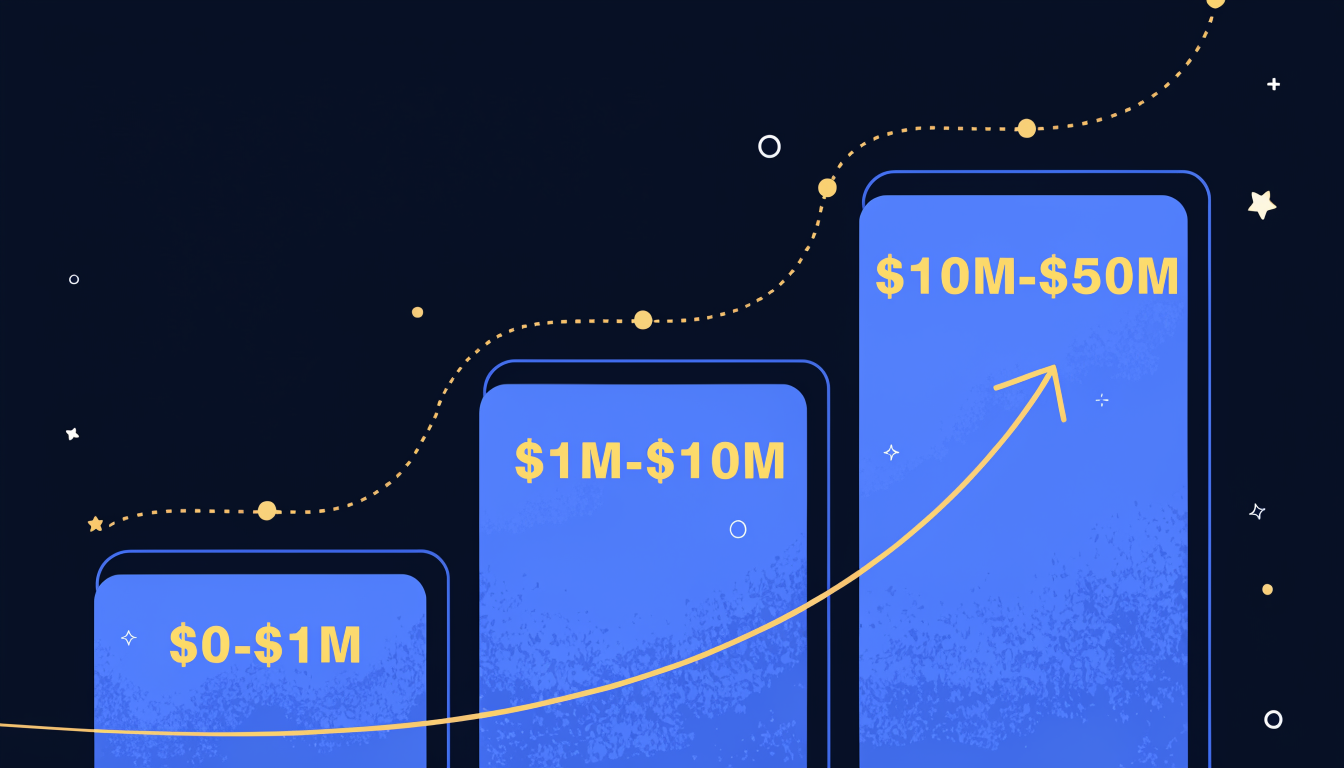
This article breaks down what your GTM should look like at three revenue stages: $0–$1M, $1M–$10M, and $10M–$50M. Each section covers motion, team, channels, metrics, and the mistakes that stall companies at that stage.
Why does revenue stage matter more than industry for GTM strategy?
Because your constraints change, not your market.
A Series A fintech startup and a Series A dev tools startup face more similar GTM challenges than a seed-stage fintech and a Series B fintech. The fintech at seed has 8 employees, no sales team, and $5K/month marketing budget. The fintech at Series B has 60 employees, a 5-person sales team, and dedicated RevOps.
Same industry. Completely different GTM reality.
Revenue stage determines your:
- Team capacity — 8 people can't run 4 channels simultaneously
- Data availability — you can't build data-driven ICPs without 100+ closed deals
- Brand recognition — outbound works differently when nobody's heard of you
- Budget — $5K/month and $100K/month require different channel strategies
- Hiring priorities — your first AE matters more than your first CMO
The frameworks that matter at each stage are different. At $0–$1M, you need founder-led sales and PMF validation. At $1M–$10M, you need repeatable motion and operating cadence. At $10M–$50M, you need multi-channel scale and executive leadership.
Trying to run a $10M playbook at $500K ARR is one of the most common reasons early-stage SaaS companies burn cash without results.
What should your GTM look like at $0–$1M ARR?
Your only objective is validating product-market fit. Everything else is distraction.
At this stage, you don't have enough data to make strategic GTM decisions. You don't know which channels will work, which ICP segment will stick, or what pricing resonates. Your job is to find out — by talking to customers and closing deals personally.
Motion: Founder-led sales, exclusively
The founder is the sales team. This isn't a compromise — it's the correct strategy.
Stripe's Patrick and John Collison personally onboarded their first 20 customers from the YC network. They'd show up at startups, open laptops, and integrate Stripe on the spot. Their "Collison Installation" method — "give me your laptop, I'll set it up" — generated more learning than any sales hire could have.
Datadog spent their first six months writing zero code. Only customer discovery. They sold month-to-month contracts to get immediate churn feedback. Every engineer did support rotation.
The pattern is consistent across early-stage SaaS: hiring sales professionals before documenting the founder's sales process leads to stalled or delayed product-market fit.
Team: 7–13 people, no dedicated sales or marketing
OpenView's 2024 benchmarks show a median of 7 employees (range 5–15) at this stage. AI-forward companies are running as lean as 7 FTEs, down from 12 in 2023.
You don't need a marketer. You don't need a salesperson. You need founders who can sell, build, and support simultaneously.
Channels: Personal network, direct outreach, product virality
Don't try to run content, paid, outbound, partnerships, and events at the same time. Pick one or two channels that match your strengths.
Channel options at this stage:
| Channel | Best for | Timeline | Budget |
|---|---|---|---|
| Personal network | B2B with warm intros | Immediate | $0 |
| Direct outreach (events, hackathons) | Dev tools, technical products | 1–2 months | $0–$2K |
| Product virality/referral | Products with built-in sharing | 2–4 months | $0 |
| Content/SEO | Products with long research cycles | 3–6 months | $0–$5K |
Figma's 10th employee, Claire Butler, spent her first six months doing manual community building with designers on Twitter. No marketing budget. No paid acquisition. Just direct engagement with the target audience.
Metrics: Retention, not growth
At $0–$1M, the metrics that matter are signals of product-market fit, not revenue growth.
PMF signals to track:
- Retention (D30): >40% indicates PMF
- NPS: >50 indicates strong product-market fit
- Organic growth: >30% of new users from word of mouth
- Churn: <2% monthly
- Gross dollar retention: 97% median (OpenView 2024)
If your retention is below 40% at D30, you don't have a GTM problem. You have a product problem. Fix that first.
Common mistakes at $0–$1M
- Hiring sales before documenting the founder's sales process. Record your calls. Write down objection handling. Document what works before handing it off.
- Scaling a leaky bucket. Growth before retention is wasted money. If customers churn in month 2, more acquisition just accelerates the burn.
- Targeting too broad an ICP. Pick one beachhead segment. Get 20 customers in that segment before expanding.
- Trying multiple channels simultaneously. SaaStr's framework: find your "superpower" channel and double down. Don't spread $5K/month across five channels.
- Running a Series A playbook at pre-seed stage. Your $200K seed round doesn't fund a 3-person marketing team.
What changes when you hit $1M–$10M ARR?
You've validated PMF. Now you need to build a repeatable, scalable go-to-market machine.
This is the transition from "founder can sell it" to "anyone can sell it." The founder's job shifts from closing deals to building the system that closes deals.
Motion: Choose based on ACV
The PLG-versus-SLG debate is the wrong framing. Your motion should match your average contract value.
| ACV Range | Recommended Motion | Why |
|---|---|---|
| < $10K/year | Product-led growth (PLG) | Low CAC, self-serve economics work |
| $10K–$50K/year | Hybrid product-led sales (PLS) | Self-serve acquisition + sales expansion |
| $50K–$250K/year | Sales-led with strong inbound | High-touch required, but content drives leads |
| > $250K/year | Outbound-led ABM | Enterprise deals need dedicated pursuit |
Pure PLG caps at roughly $15–25M ARR. Pure SLG is inefficient below $50K ACV. The dominant motion in 2025–2026 is hybrid — PLG for acquisition, sales for expansion.
Hiring sequence: Follow the revenue milestones
Don't hire based on what feels right. Hire based on what the data says.
| Revenue Milestone | First Hire | Why |
|---|---|---|
| $1M ARR | First AE (hire 2) | Founder can't close all deals alone; hire 2 for A/B testing |
| $2–3M ARR | Second AE + first BDR | Pipeline needs dedicated prospecting |
| $3M ARR | First CSM | Expansion revenue requires dedicated success |
| $5M ARR | Sales manager + RevOps lead | Install operating cadence |
| $8M ARR | VP Sales | Strategic leadership for scaling |
The key insight: hire 2 AEs simultaneously, not 1. You need a baseline for comparison. If you hire one AE and they underperform, you don't know if it's the hire or the process.
HubSpot's Mark Roberge was the first sales hire in 2007. He built a data-driven hiring system using regression analysis on 14 criteria, narrowing to 5 predictive traits. At roughly 1,000 customers, they segmented sales by persona — marketers at companies under 200 employees, executives at 200–2,000.
Team: 29 at $1–2.5M, 63 at $2.5–10M
OpenView's benchmarks show median headcount of 25 employees at $1–5M ARR and 65 at $5–20M. The shift from engineering-dominant to sales-dominant happens gradually through this stage.
Notion scaled to a $2B valuation with a 2–3 person growth team by externalizing work into systems — ambassadors, templates, community. Their 11th employee was Head of Marketing. Their 12th was Head of Community. They stayed at only 10% sales employees even at scale.
Metrics: Shift from PMF signals to efficiency metrics
| Metric | $1–$5M Benchmark | $5–$10M Benchmark | Source |
|---|---|---|---|
| ARR growth (median) | 100% YoY | 72% YoY | OpenView 2024 |
| NRR (median) | 105% | 111% | OpenView 2024 |
| CAC payback | 15 months | 15 months | Bessemer |
| LTV:CAC | 3:1 minimum | 4:1+ target | Bessemer |
| Gross margins | 70% | 80%+ | Bessemer |
| S&M spend (% of revenue) | 32% | 33% | OpenView 2024 |
What changes operationally
- Formalize customer success. Expansion revenue starts to matter. You need someone owning retention and upsell.
- Codify ICP with data, not gut feel. You have 50+ closed deals now. Analyze which segments convert fastest, churn least, and expand most.
- Install operating cadence. Weekly pipeline reviews, monthly business reviews, quarterly planning. Before $3M, this can be informal. After $3M, it needs to be systematized.
- Build metrics infrastructure. CAC by channel, pipeline velocity, LTV by segment. You can't optimize what you don't measure.
- Document the sales playbook. This takes one weekend and pays off for years. Record calls, write scripts, codify objection handling.
Common mistakes at $1M–$10M
- Operating model debt. Keeping informal processes past $3M creates chaos at $8M.
- One person doing PM + CS + marketing. By $5M, this person is burned out and all three functions are underperforming.
- Gut-feel decisions instead of metrics-driven. You have the data now. Use it.
- Adding complexity too fast. Don't add a second GTM motion yet. Perfect one before adding another.
- Not documenting the sales playbook. When your first AE leaves, you'll wish you had.
How does GTM evolve at $10M–$50M ARR?
This is where most SaaS companies stall. You've found product-market fit. You've built a repeatable motion. Now you need to scale it — and add a second one.
The objective shifts from "build the machine" to "add engines to the machine."
Motion: Add your second GTM motion
At $10M ARR, you're running 1–2 channels. By $50M, you need 4–6. Channel concentration above 50% at $30M+ is a board-level risk.
The second motion depends on your first:
- PLG-first → add enterprise sales. Stripe, Figma, and Notion all followed this pattern. Bottom-up adoption creates internal champions at large companies. Your job is to build a sales layer that converts those champions into enterprise contracts.
- SLG-first → add self-serve/PLG. HubSpot did this in reverse — started with sales-led, added freemium later. This is harder because it requires product changes, not just GTM changes.
Stripe added an enterprise sales layer around 2018–2020, triggered by existing product usage at large companies creating internal champions. They now run a hybrid model: PLG self-serve + enterprise sales + 12,000+ partner platforms.
Team: From founder-led to executive-led
This stage requires building an executive layer. The founder can't manage a 60-person GTM org directly.
| ARR Range | Org Shape | Key Hires | Focus |
|---|---|---|---|
| $10–15M | Founder + 1 VP | VP Sales, Head of CS | Sales motion repeatability |
| $15–25M | 3–4 VPs | CMO, VP Engineering | Segmented GTM motion |
| $25–35M | CRO + exec team | CRO, CFO, VP People | Multi-channel scale |
| $35–45M | COO or CRO consolidation | COO, Head of RevOps | Operating-system discipline |
| $45M+ | Full exec layer | International leads | Compound growth + margin |
ICONIQ's 2026 data shows AI-forward companies running roughly 20 GTM FTEs at $10–25M ARR versus 35 for lower-adoption peers — a 43% difference. At $25–100M, the gap widens: 45 FTEs versus 65.
Metrics: Efficiency at scale
| Metric | $10–25M Benchmark | $25–50M Benchmark | Source |
|---|---|---|---|
| ARR growth | 135%+ (top quartile) | 110%+ (top quartile) | Bessemer |
| NRR | 135%+ (top quartile) | 130%+ (top quartile) | Bessemer |
| Gross margins | 80%+ | 75%+ | Bessemer |
| Magic number | >0.75 | >0.75 | Bessemer |
| CAC payback | <18 months | <18 months | Bessemer |
| Rule of 40 | Growth + margin ≥ 40 | Growth + margin ≥ 40 | Industry standard |
Expansion revenue becomes the primary growth engine. At $50M+ ARR, roughly 60% of new ARR comes from existing customers (High Alpha 2025).
Net revenue retention benchmarks: median 100% at $1–5M ARR, rising to 105% at $5–20M (OpenView 2024). Top performers target 110%+ at $10M and 120%+ at $50M. If your NRR is below 100%, you're churning more revenue than you're expanding. Fix that before scaling.
Channel mix: From 1–2 to 4–6
| ARR | Channels | Dominant Source |
|---|---|---|
| $10M | 1–2 | Outbound + inbound, or PLG |
| $20M | 2–3 | Add partner/channel |
| $30M | 3–4 | Add paid + community |
| $50M | 4–6 | Full mix: outbound, inbound, partner, paid, community, events |
Events and conferences ranked as the number-one most effective channel across all ARR bands in High Alpha's 2025 benchmarks. Among high-growth companies under $100M, sales-sourced pipeline accounts for roughly 62% of total; marketing-sourced, roughly 19% (ICONIQ 2026).
Segmentation: Expand carefully
Most companies segment by geography and company size first. Industry verticalization comes later as you move upmarket.
Each segment expansion — SMB to mid-market, mid-market to enterprise — introduces different sales cycles, ACVs, and onboarding requirements. Trying to serve all three segments simultaneously is a stall pattern.
HubSpot segmented their sales by persona at roughly 1,000 customers. They created separate teams for agencies, media, and ecommerce. Channel partnerships became roughly 10% of revenue.
Common mistakes at $10M–$50M
- Channel concentration above 50%. If one channel drives more than half your pipeline, you're one algorithm change or market shift away from a revenue crisis.
- Serving all segments simultaneously. Pick one expansion direction. Master it. Then add another.
- Skipping RevOps. At $10M+, you need someone owning the data infrastructure, process consistency, and tool stack. This isn't a marketing ops role — it's a strategic function.
- Hiring executives too late. The VP Sales you need at $8M should have been hired at $5M. The CRO you need at $25M should have been hired at $18M.
- Ignoring expansion revenue. If 60% of new ARR at $50M comes from existing customers, your customer success function is your most underfunded GTM lever.
Which metrics should you track at each revenue stage?
The metrics that matter change as you scale. Tracking the wrong ones at the wrong stage leads to bad decisions.
| Metric | $0–$1M | $1M–$10M | $10M–$50M |
|---|---|---|---|
| Primary focus | PMF validation | Efficiency | Scale + expansion |
| Retention (D30) | >40% | — | — |
| NPS | >50 | — | — |
| Churn (monthly) | <2% | <1.5% | <1% |
| NRR | 100% | 100–105% | 105–120% |
| CAC payback | — | 15 months | <18 months |
| LTV:CAC | — | 3:1+ | 3:1+ |
| Gross margins | 70% | 70–80% | 75–80% |
| Magic number | — | — | >0.75 |
| Rule of 40 | — | — | Growth + margin ≥ 40 |
| YoY growth | 100% median | 72–100% | 72–135% |
| S&M spend (% rev) | 32% | 32–33% | 33% |
Sources: OpenView 2024 SaaS Benchmarks (3,000+ companies), Bessemer BVP Atlas, ICONIQ 2025–2026 GTM Reports.
How do you know when it's time to transition to the next stage?
Revenue is a lagging indicator. Use leading signals to know when to restructure your GTM.
Signals to move from $0–$1M to $1M–$10M
- Founder is the bottleneck. Deals are stalling because the founder can't handle volume.
- Repeatable close pattern. You've closed 10+ deals with similar process, similar objections, similar timeline.
- Retention is proven. D30 retention >40%, monthly churn <2%.
- ICP is narrowing. You're seeing clear patterns in who buys and who doesn't.
- Revenue threshold. $800K–$1M ARR with 3+ months of consistent pipeline.
Signals to move from $1M–$10M to $10M–$50M
- Single channel is maxing out. Your primary channel's growth rate is decelerating.
- Hiring isn't keeping up. You're adding headcount but not seeing proportional revenue growth.
- Expansion revenue is growing. Existing customers are asking for more — more seats, more features, more products.
- Segment pull. A new segment (enterprise, international, vertical) is pulling you in without you pursuing it.
- Revenue threshold. $8–$10M ARR with consistent operating cadence for 2+ quarters.
Frequently asked questions
Should a bootstrapped SaaS follow the same GTM stages as VC-backed?
The stages are the same. The timeline and budget are different. Bootstrapped companies should spend longer at each stage, be more disciplined about channel selection, and avoid premature hiring. The metrics benchmarks still apply — you just reach them with less capital.
Can PLG work at every revenue stage?
PLG works at every stage, but it changes form. At $0–$1M, it's freemium or free trial driving signups. At $1M–$10M, it's self-serve acquisition feeding a sales team. At $10M–$50M, it's bottom-up adoption creating enterprise champions. Pure PLG caps at roughly $15–25M ARR — you need to add sales to go further.
When should you hire your first VP Sales?
At $5–$8M ARR, not before. Before $5M, you need a sales manager who can coach AEs and maintain process consistency. A VP Sales at $2M ARR is overkill — they'll spend their time managing 2 people instead of building strategy. Hire the VP when you have a team of 5+ reps and need someone to build the scaling playbook.
How does AI change GTM at each stage?
AI-forward companies run 20–38% leaner GTM teams (ICONIQ 2026). At $0–$1M, AI tools reduce the need for early hires — founders use AI for prospecting, content, and support. At $1M–$10M, AI handles repetitive tasks (lead scoring, email sequences, content drafts) so humans focus on high-touch activities. At $10M–$50M, AI enables personalization at scale without proportional headcount growth. Companies with high AI adoption hit quota at 67% versus 59% for low-adoption peers.
Let's turn your content into pipeline.
Tell us what you are working on. No pitch deck, no pressure. We'll review the context and tell you honestly whether Rampkit makes sense for where you are.