What Is a Content Brief for AEO? What B2B SaaS Teams Need to Know
Learn what an AEO content brief includes, how it differs from an SEO brief, and how B2B SaaS teams can create answer-ready content.
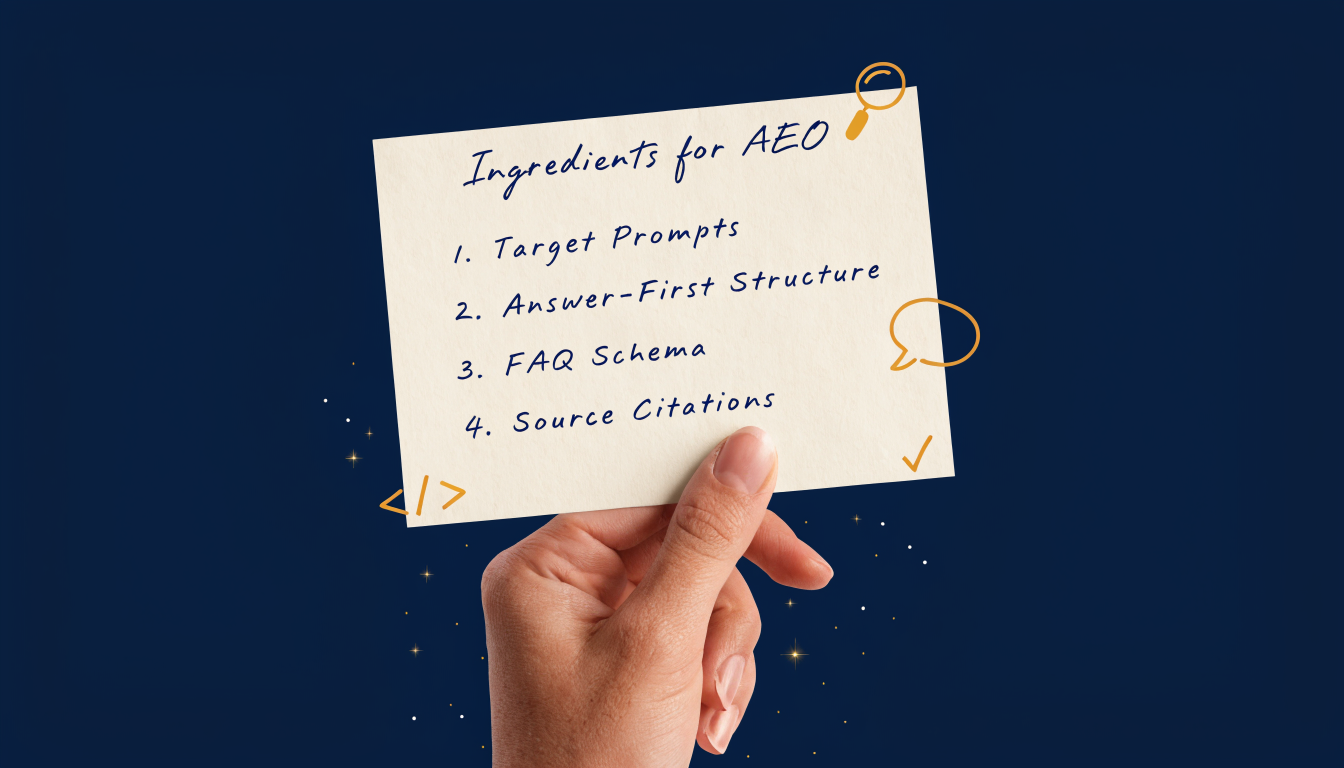
A content brief for AEO (Answer Engine Optimization) is a structured planning document that tells a writer exactly how to produce content that AI engines will cite, extract, and recommend. It goes beyond a traditional SEO brief by specifying answer format, schema markup, direct-answer sentence placement, FAQ structure, and source citation requirements, the structural decisions that determine whether AI systems like ChatGPT, Google AI Overviews, and Perplexity pull your content into their answers.
If you're a B2B SaaS team trying to get your product mentioned when buyers ask AI tools for recommendations, the brief is where that strategy either takes shape or falls apart. Most teams skip it or treat it like a regular SEO brief with a few extra fields. That's why their content ranks but never gets cited.
This guide covers what an AEO content brief includes, how it differs from a standard SEO brief, and what actually makes one work for B2B software companies.
What is an AEO content brief?
An AEO content brief is a pre-writing document that specifies the structural, strategic, and schema requirements a piece of content must meet to earn citations from AI answer engines. It's the blueprint a writer follows to produce content that AI systems can parse, trust, and extract answers from.
A standard SEO content brief typically includes:
- Primary keyword and secondary keywords
- Search intent classification
- Target audience definition
- Suggested headings (H2/H3 outline)
- Word count target
- Internal and external link targets
- Competitor URLs to beat
An AEO content brief adds several layers on top of that:
- Target prompts, the exact questions buyers type into ChatGPT, Perplexity, or Gemini (not just Google keywords)
- Answer-first structure, the first sentence under every H2 must directly answer the heading question in 40 to 60 words
- FAQ section requirements, specific questions sourced from People Also Ask, with standalone answers
- Schema markup specifications, FAQPage, Article, HowTo, or Product schema with required properties
- Source citation requirements, named sources for every stat, linked inline
- Author credentials, E-E-A-T signals that help AI systems assess trust
The brief sits between your AEO strategy and the actual content. Without it, writers produce content that might rank in traditional search but gets overlooked by AI answer engines because the structure isn't optimized for machine extraction.
How is an AEO content brief different from an SEO brief?
The core difference is what each brief optimizes for.
An SEO brief optimizes for ranking in a list of links. It focuses on keyword placement, meta tags, heading structure, and backlink strategy. The goal is to appear on page one of Google.
An AEO brief optimizes for being cited inside an AI-generated answer. It focuses on extractable structure, direct-answer formatting, schema markup, and source credibility. The goal is to be the source an AI engine quotes when answering a buyer's question.
Here's how the two compare across key dimensions:
| Dimension | SEO Brief | AEO Brief |
|---|---|---|
| Primary target | Google search results page | AI-generated answers (ChatGPT, Gemini, Perplexity, AI Overviews) |
| Keywords | Traditional keyword research | Target prompts, the exact questions buyers ask AI tools |
| Heading structure | Keyword-optimized H2s | Question-format H2s with direct answer sentences |
| Content format | Flexible, longform, listicles, guides | Structured for extraction, definitions, tables, numbered steps, FAQ blocks |
| Schema | Nice to have | Required, FAQPage, Article, HowTo with specific properties |
| Statistics | Support claims | Must be cited with named sources, AI engines prefer cited claims |
| Success metric | Rankings, organic traffic, CTR | AI citation rate, mention frequency, recommendation share |
The practical implication: a page optimized only for SEO might rank well in traditional search but get completely ignored by AI answer engines. A page optimized for both earns traffic from Google and gets cited in AI-generated answers.
For B2B SaaS companies, this distinction matters because buyers increasingly use AI tools to research software. If your product doesn't show up when someone asks ChatGPT "What are the best [category] tools for [use case]?", you're invisible to a growing segment of your market.
What goes into an AEO content brief?
A complete AEO content brief contains these sections:
1. Target query and intent
The primary question the content must answer, sourced from Google Search Console, People Also Ask, or actual AI tool queries. Include 5 to 8 secondary questions that become H2 sections. Classify the intent: definitional, procedural, comparison, or decision.
2. Content format and schema
Specify the content type (guide, comparison, how-to, definition) and the schema markup required. For most B2B SaaS content, this means FAQPage and Article schema at minimum. Comparison pages add Product schema.
3. Word count and section structure
Set a target word count with per-section allocation. A typical AEO-optimized piece runs 1,500 to 2,500 words. Each H2 section should be 150 to 300 words, self-contained enough for AI engines to extract independently.
4. Key facts and statistics
List 3 to 5 specific statistics the content must include, with source names and publication years. AI engines preferentially cite content with verifiable numbers. Generic claims get ignored; sourced data gets quoted.
5. Internal link targets
Name 3 to 5 internal pages to link contextually. Not in a footer or sidebar, placed where the link adds value to the reader's understanding.
6. Competitor gaps
Identify 2 to 3 specific topics or angles that the top-ranking pages miss. These become required sections in the content, the differentiation that makes your page worth citing over competitors.
7. Schema output requirements
Provide the actual JSON-LD template or at minimum the required properties. Don't just write "add FAQPage schema", specify that the schema must include the exact questions and answers visible on the page.
8. Editorial rules
Non-negotiable writing instructions: no em-dashes, lead with answers, active voice, source every stat, first sentence under each H2 must stand alone as a quotable statement.
Why do most B2B SaaS teams struggle with AEO briefs?
The template is the easy part. The hard part is filling it with the right decisions.
Here's where most teams get stuck:
They don't know which prompts to target. Keyword research tools show Google search volume. They don't show what buyers are asking ChatGPT or Perplexity. Without that data, teams guess at target prompts and often miss the queries that actually drive AI citations.
They can't identify the right gaps. Spotting what competitors miss requires reading the top 10 results, understanding the buyer's decision process, and recognizing where the existing content is shallow. That's product marketing judgment, not a checkbox exercise.
They underestimate the schema work. Writing "add FAQPage schema" in a brief is easy. Specifying the exact questions, mapping them to visible page content, and providing a valid JSON-LD template that a developer can implement, that requires someone who understands both content strategy and technical SEO.
They treat the brief as a form to fill out. A good AEO brief is a set of strategic decisions about what the content must achieve. A bad one is a template with blank fields. The difference is who fills it in.
They don't have a PMM. A content brief for AEO requires understanding your product's positioning, your buyer's evaluation process, and your competitive space. At most B2B SaaS companies (especially seed to Series A), that knowledge lives in the founder's head, and the founder doesn't have time to write briefs.
This is the real constraint. The AEO content brief template is free. The judgment to fill it correctly is not.
What makes an AEO content brief actually work for B2B SaaS?
Beyond the template, three factors determine whether a brief produces content that earns AI citations:
1. Product-specific positioning, not generic coverage
Most AEO briefs optimize for topic coverage, "make sure you mention X, Y, and Z." That produces content that sounds like every other article in the category. AI engines have plenty of generic content to cite. What they lack is specific, differentiated perspectives.
A brief that works specifies not just what to cover, but what angle to take. It includes your product's positioning against alternatives. It names the specific pain points your buyers have that competitors don't address. It forces the writer to produce something an AI engine can't find elsewhere.
2. Buyer-journey alignment
A "what is X" query has different intent at different stages. A founder exploring AEO for the first time needs a definition. A marketing manager evaluating implementation needs a comparison. A content lead building a process needs a template.
The brief must specify which stage the content targets and structure accordingly. Most briefs skip this, which is why the resulting content tries to serve everyone and serves no one well enough to get cited.
3. Source architecture
AI engines assess credibility by checking whether claims are supported by named sources. A brief that works doesn't just say "include statistics", it lists the specific stats, their sources, and where they should appear in the content. This turns a generic article into a citable reference.
Can AI generate AEO content briefs?
Partially. AI tools can analyze search results, extract common headings, and suggest a basic outline. For straightforward informational queries, an AI-generated brief produces a reasonable starting point.
But AI-generated briefs miss the elements that matter most for B2B SaaS:
- Product positioning, AI doesn't know how your product differs from competitors or what your buyers actually care about
- Competitive gaps, AI can summarize what competitors cover, but it can't identify what they're strategically missing
- Buyer intent nuance, AI treats all queries as informational. It doesn't distinguish between a founder exploring a concept and a content lead evaluating a process
- Source quality, AI will include statistics, but often from secondary sources or outdated reports
The practical approach: use AI to draft the structural elements (heading outline, word count targets, schema requirements), then have someone with product marketing judgment fill in the strategic elements (target prompts, competitive gaps, positioning angle, source list).
How do AEO content briefs connect to pipeline?
The connection is indirect but real.
A well-briefed article earns AI citations. AI citations put your brand in front of buyers who are researching solutions. Those buyers visit your site, read your content, and some of them enter your pipeline.
The brief is the control point. A bad brief produces content that ranks but doesn't get cited. A good brief produces content that gets cited and drives qualified traffic. The difference compounds over time, pages that earn early AI citations tend to keep earning them, while pages that miss the initial window struggle to catch up.
For B2B SaaS companies with lean teams, this means the brief isn't just a content operations document. It's a pipeline lever. The quality of your briefs directly affects how often AI engines recommend your product to potential buyers.
If you're looking for a partner who builds AEO-ready content briefs with product marketing depth, Rampkit's SEO and AEO content strategy service covers keyword research, intent mapping, topic clusters, and content briefs designed for B2B SaaS.
Conclusion
A content brief for AEO is the planning document that bridges your AEO strategy and your actual content. It specifies the structural, strategic, and schema requirements that make content citable by AI answer engines, not just rankable in traditional search.
The template is straightforward: target prompts, answer-first structure, schema specifications, source requirements, competitor gaps, and editorial rules. What makes it work is the judgment behind each field, understanding your product's positioning, your buyer's decision process, and where competitors leave gaps.
If you're a B2B SaaS team without a dedicated product marketer, the brief is where that gap shows up most clearly. You can fill in the template. But filling it with the right strategic decisions, the ones that produce content AI engines actually cite, requires product marketing depth.
That's the difference between content that ranks and content that gets recommended.
Frequently Asked Questions
What is the difference between an AEO content brief and a regular content brief?
A regular content brief focuses on keyword targeting, heading structure, and basic SEO requirements. An AEO content brief adds answer-first formatting, schema markup specifications, FAQ requirements, source citation rules, and target prompt analysis, the structural elements that make content extractable and citable by AI answer engines.
How long should an AEO content brief be?
An AEO content brief typically runs 500 to 800 words for a standard blog post and 800 to 1,200 words for a pillar or comparison page. The length comes from specifying structural requirements in detail, not from adding filler, but from making decisions the writer would otherwise make alone.
Who should create AEO content briefs for a B2B SaaS company?
Someone with product marketing judgment, ideally a PMM or content strategist who understands your product's positioning, buyer journey, and competitive space. At lean teams without a dedicated PMM, this responsibility often falls to the founder or a content partner who can translate product knowledge into structured briefs.
Do AEO content briefs need schema specifications?
Yes. Schema markup (FAQPage, Article, HowTo, Product) helps AI engines understand your content's structure and purpose. A brief that says "add schema" without specifying the required properties produces inconsistent implementation. The brief should include the schema type, required properties, and ideally a JSON-LD template.
Can I use the same brief for SEO and AEO?
You can combine them, but the AEO-specific requirements must be explicit. A brief that includes only SEO elements (keywords, meta tags, headings) produces content that might rank but won't get cited by AI engines. The answer-first structure, schema requirements, and source citation rules need to be called out as separate, non-negotiable sections.
Let's turn your content into pipeline.
Tell us what you are working on. No pitch deck, no pressure. We'll review the context and tell you honestly whether Rampkit makes sense for where you are.